Find Us:
77 Fernvale Rd
Brassall QLD 4305
(07) 3201 8630
Open:
Tue-Sun 9am - 4pm

Caladium
Caladiums are grown for their beautiful leaves which appear in the warmer months from corms. The older and fuller in the pot or garden the better the leaf colour.
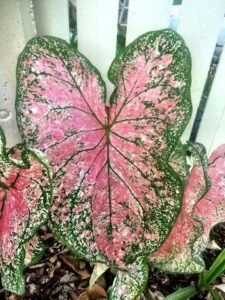
One of my all time favourite plants is the Caladium.
I have heard some people call caladiums garish, with their vibrant leaf colours, but I adore them.
I usually grow my caladiums in a shady spot in the garden, but I do keep a few in pots that I can bring inside during the warmer months, as it’s one of the best plants to have indoors during the heat.
Caladiums are known for their beautiful leaves which appear in the warmer months from corms. The older and fuller in the pot or garden, the better the leaf colour, so try not to split your caladiums too often.
Their foliage is absolutely amazing and constantly changing, plus they get bigger and better every year. Their leaves can range in size from about 10cm to about 50cm and the colour can range from transparent, pink, through to dark vibrant red with splashes of green. There are so many colour combinations I don’t think I could ever collect them all … I do plan on trying though!
To gift a Caladium means you are gifting the recipient joy and delight in their lives and this is exactly what caladiums do for me, bring me joy and delight.
As soon as they start to pop up from underground and show their foliage off, I bring the pots inside. They will survive inside in a well lit area and I find the darker the spot the less colour the foliage gets. They also don’t like cold houses, so try to find a warmer spot.
They adore the heat and humidity and they don’t require a lot of water, about once a week during the really hot times and the ones in the garden get watered and treated the same as all other plants.
I use them all throughout the house at this time of year to add colour to a sometimes solely green landscape.
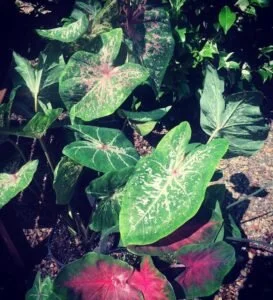
When the cooler weather approaches and they start to die down, I put the pot back outside in a warm shady spot and leave it alone until it pops up again next year.
If you are growing your Caladiums in the ground, I don’t ever pull them up when they die down. I find the older they get, the better they look. As soon as the nights start to warm up, these beauties will pop up from underground to surprise you with their colours and then as the nights start to get too cold they will slowly disappear again....
I try to fertilise my Caladiums in August, just before it starts to get warm, with Organic Link. Through their growing season, I alternate liquid fertilising them with Silica and Potash and Triple Boost.
I love the way caladiums can instantly lift my mood with their tropical feel and I think they add a colourful, magical touch to your garden.
Caladiums are available at Trevallan from November to March

What Seed Do I Buy
Buying open pollinated, no chemical treatment, bio dynamic seeds is ‘the best option’ for starting your thriving vegetable garden. We have chosen Eden Seeds as they are a great Australian company with an ethos we align with. They stock both Organic and no chemical treatment, Bio dynamic seeds and we try to stock a good range of both.
When we bought Trevallan nearly 24 years ago our experience with seeds was minimal.
My grandfather always reused his own seed and that was considered normal.
When we bought Trevallan we had three different seed companies in stock and within a few short months most of our complaints came about due to seed issues.
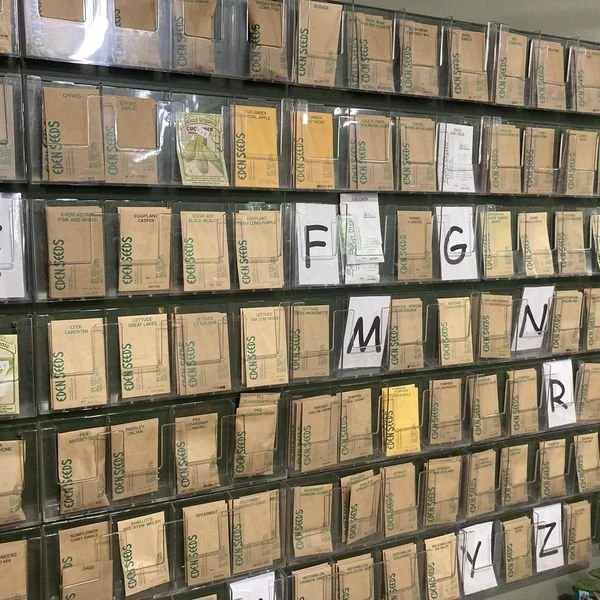
So started a research project into something entirely new for us, using customer recommendations and my grandfather as our test subject!
Very quickly we converted to Eden Seeds.
Very quickly our seed problems diminished and demand for seeds grew until now where we have the Great Seed Wall!
So what were our problems with some of the seeds we used to stock.
Low germination rates (by experienced growers)
What grew wasn’t exactly the same as what it was marked as
Problems with growing past a certain point
Major problem was not being able to collect seed reliably for future cropping. This was something my grandfather always did. It was very important
We discovered Eden Seeds. Eden Seeds states “aim is to distribute old traditional open pollinated varieties of vegetable seed, preferably old Australian varieties and organically or bio-dynamically grown where possible. We believe they are more nutritious and better tasting, hardy and easier to grow for the home gardener. Old varieties produce over an extended period. Home gardeners obtain relaxation, enjoyment and quality from a most rewarding hobby. Our seeds are the old traditional open pollinated non-hybrid varieties and have no chemical treatment, and no genetic engineering.”
This sounded great to me but first I needed to understand what that all meant!
Hybrid Seeds
Hybrid seeds are produced through careful pollination of two specific varieties by human intervention. Normally, this highly selective plant breeding is done to bring together two traits in each of the chosen varieties so that the resulting seed has both of the traits
An example may be a cabbage that grows huge but is susceptible to disease. A smaller-growing cabbage is very disease resistant. They combine the two and boom a large cabbage head that is disease resistant. Usually, you can’t reseed these plants as the seeds may not contain the characteristics of the hybrid plant.
Positive of Hybrid Seeds Hybrid seeds are believed to have better disease resistance and perform better in terms of more fruits, flowers and vegetables produced.
Negative of Hybrid Seeds Hybrid seeds tend to be more expensive to buy due to the specialized pollination process and the seeds you collect from them will not grow the same plant next year and, in some cases, have been bred so that no plant at all can grow from the seeds of a hybrid plant.
Non-Hybrid
Non-hybrid seeds, or open-pollination seeds, are naturally pollinated naturally (bird, insect, wind). They come in a wealth of different varieties and produce seeds that grow into plants with similar characteristics as the original plant. Over successive generations, non-hybrid plants may also adapt to local growing conditions, making them stronger plants, and ultimately less susceptible to local pests and disease.
Using non-hybrid seeds has another advantage: you’re helping preserve the biodiversity of our food supply. Many of the rarer “heirloom” and “heritage” seed varieties would be extinct were it not for the efforts of non-hybrid gardeners and farmers
Genetically modified organisms (GMO)
GMO seeds are produced by genetic engineering, altering the genetic material of an organism. This is different from hybrid seeds that are produced by cross-breeding of two varieties through artificial mating
Organic vs Non Organic
You can buy Organic hybrid seeds and organic non hybrid seeds You can not buy organic GMO seeds. Many people tell me that they buy their fruit and vegetables organically so they just reseed their garden from that. You can buy hybrid organic vegetables and seed. This means while your seed is organic your vegetables may not regrow true to the plant you purchased.

Australian Organic Laws are very strict, always look for the Australian Organic Certification stamp when buying organic products. In Australia, the Australian Certified Organic (ACO) standards require organic seed producers to use organic practices and to undergo an annual certification process. The certification process for organic seeds involves ensuring the land is free from synthetic chemicals, using organic methods for seed production, and processing the seeds without synthetic chemicals.
No Chemical Treatment
Untreated seed is classed as ‘clean’ seed and has not been treated using any chemical, biological, or physical method. While untreated seed can be grown under organic conditions, the seed crop was not grown under Certified Organic Conditions. As the Certification process can be lengthy and costly many farmers choose the no chemical treatment option. Untreated seed is a popular alternative to organic seed.
Bio-dynamic
Bio-dynamic seed crops are grown in living soil within a diverse thriving ecosystem. Not a sterile environment such as under growing houses or single crop acres. Seed produced from this growing environment is bred to thrive in organic/bio-dynamic growing conditions.
Best Seed?
A lot of information to cover there but as you can see buying open pollinated, no chemical treatment, bio dynamic seeds is dare I say it ‘the best option’ for starting your thriving vegetable garden.
Eden Seeds
We have chosen Eden Seeds as they are a great Australian company with an ethos we align with. They stock both Organic and no chemical treatment, Bio dynamic seeds and we try to stock a good range of both. Our Great Wall of Seeds is constantly changing and evolving to supply you with not only the best seed but the best diversification so we all aren’t stuck growing just beans!
Choosing what seed to grow… Well that is another story!
How Do I choose what Seeds to Plant?
Sharing my vegetable gardening experiences with you so hopefully you don't make the same mistakes as me.
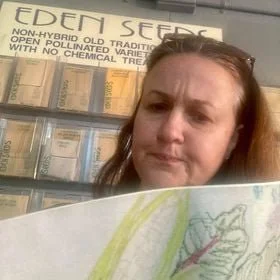
Me looking extremely perplexed about what to plant!
I remember reading my first ever Eden seeds catalogue. I think I had ever second seed variety highlighted. We were going to grow five different types of beans … I hate beans... I think I thought if I grew them, I’d eat them!
What I ended up with was a seed draw full of seeds, an over grown vegetable patch and too much produce all at once.
I’m a little bit wiser now, little bit!
I thought I’d share some of my vegetable gardening experiences with you so hopefully you don't make the same mistakes as me.
My first piece of advice is realising I am not Annette McFarlane, Claire Bickle, Jerry Colby-Williams or Jamie Oliver. Yes, I want to plant all the edibles but really am I going to cook, preserve and then eat all the edibles. Do I even have the space, time or know how?
Realisation, I do not enjoy cooking or preserving. Nor do I have the capacity to store a lot of those things.
I need to make sure I plant mainly what I can eat and cook with and maybe one different thing every season to broaden my horizons
Some of you think you want to cook and preserve but just make sure you’ve attempted this before or at least know what’s involved. Thinking you are going to be that person that makes a huge batch of tomato sauce or chutney, is a lot different to the person who is in a kitchen doing it all day long. I did this as a child with my grandmother and I hated it, as an adult I gave it another go and hated it.
I realised my passion was in eating not cooking! I now surround myself with a lot of happy chefs in my life that willing take the food I grow and magically turn it into yummy things in jars for me to eat!
I need to successive plant. Planting 12 lettuces isn't the best way forward for me. I’m not even sure I know 12 people to share 12 lettuces with. It’s better if I plant four lots of lettuce. Sowing some seeds every month so I have a continuous supply and not everything all at once. Unless you like lettuce soup!
To work out what to plant, I first work out what I eat a lot of. I then work what is really cheap at the stores when in season. For example we eat a lot of broccoli but by the time I get a good crop of broccoli, it's readily available at the shops and it’s a good price. Broccoli takes up a lot of space in the garden and can be hard to get a good crop so I leave that one for the professionals. On the other hand we eat a lot of tomatoes and they are never cheap, nor do they taste any good so that something I will definitely grow. Once I work out my basic favourite things to eat and grow I always like to throw something a little different into the mix. Maybe we love Silverbeet but instead of growing green silverbeet we grow rainbow silverbeet.
I always love to choose a vegetable that sounds yummy but I haven’t incorporated into my food before and grow that too just to see what it’s like.
Buy good quality non hybrid seeds or good quality established plants from known growers. Try really hard not to grow things from scraps.
If I’m really struggling with what to plant one season, I grow herbs. I can always use herbs, herbs are easy to grow and herbs are easy to share with friends.
Start small, then go big. Unless you have the time, energy and skills start small. There is nothing wrong with planting three edibles. There is nothing wrong with planting ten edibles. It doesn't matter. What matters is that you are doing it.
Finally my biggest piece of advice is don’t scrimp on soil. Soil is the key to a healthy garden. Buy the good soil, make the good soil. Have organic fertiliser on hand and use it. Healthy soils make plants thrive not just survive. Growing your own food can be so rewarding but follow the steps and get good advice.
Always remember There are no gardening mistakes, only experiments. – Janet Kilburn Phillips!
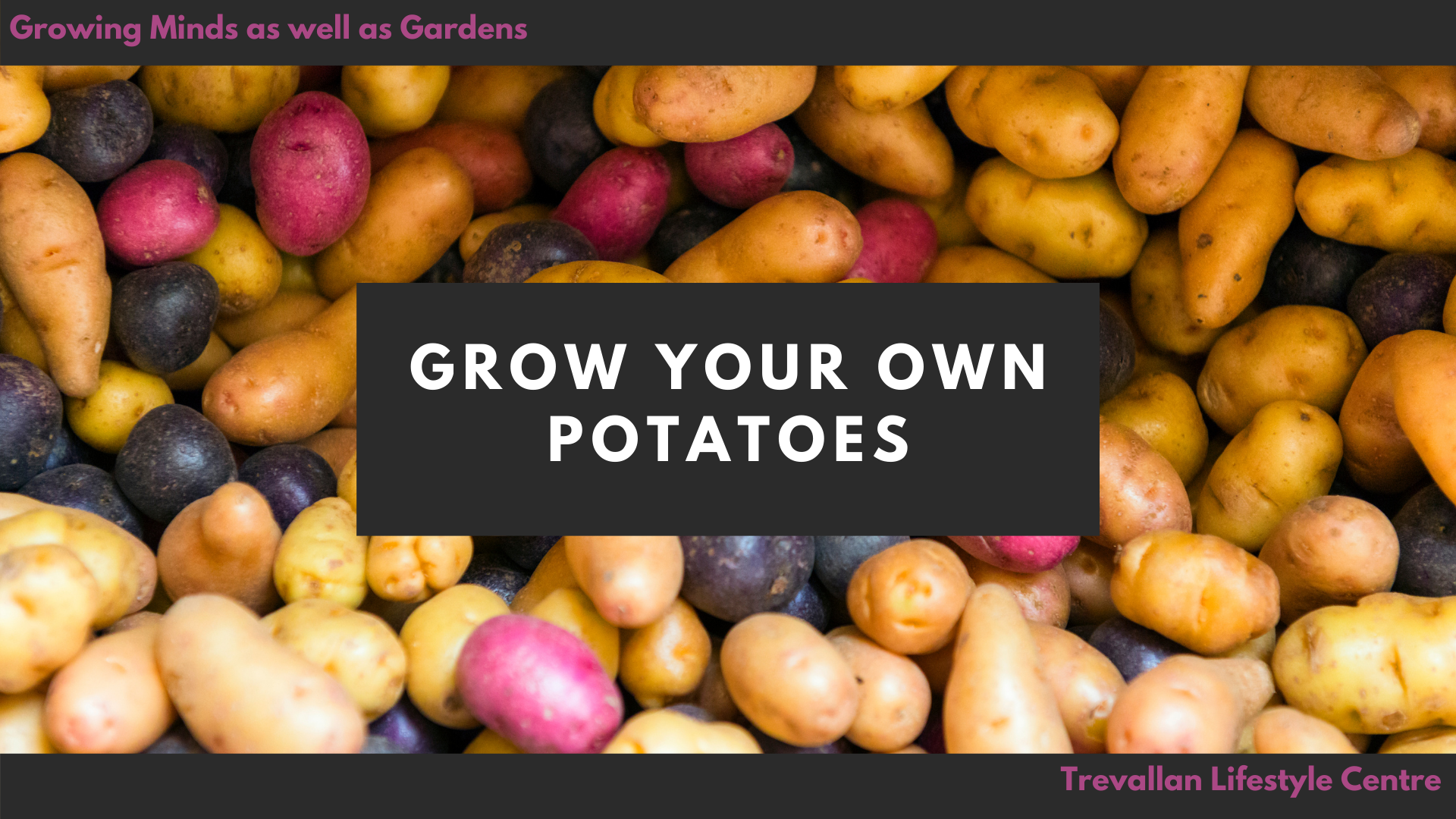
One Potato, Two Potato, Three Potato
Grow your own potatoes from certified organic seed. Did you know that 29 pesticides are commonly used when growing potatoes?
The first time I heard the words seed potato I imagined a packet of seeds looking somewhat like bean seeds! How wrong I was. Seed Potatoes are what you use to grow potatoes and look like baby potatoes. About 1kg of certified seed should produce about 10kgs of potato.
Woolworths sells potatoes for around $1kg sometimes, why am should I grow them myself?
Potatoes rank among the most contaminated with pesticides and fungicides. Twenty-nine pesticides are commonly used, and 79% of potatoes tested exceed safe levels of multiple pesticides (according to research done by FDA and USDA). Now I don't know about you but I used to use potatoes all the time in cooking. So this little piece of information didn't sit terribly well with me. If I started buying organic potatoes it would cost me upwards of $6kg. So growing potatoes seems like a good idea.
Why should I buy certified seed potato, why can’t I just plant the sprouts that grow from my potatoes from the grocery store?
Firstly potatoes are sprayed with growth inhibitors to stop them from sprouting in shops? This means that when they do finally sprout the growth may be inhibited. You may get weak growth, deformed growth or a plant more susceptible to insect and fungus attack.
Potato plants can carry many potato diseases: bacterial, viral, and fungal; and some of these are passed on through potato tubers. Plant viral infections are persistent and can not only affect your potato plants but your neighbourhood’s plants as well. All plants in the potato family can be affected like tomatoes, eggplants and chillies. These diseases can also contaminate soil and make an area implantable. Remember the Great Famine? Caused by potato blight!
If using non certified seed potatoes the chance of having a disease outbreak is increased. This is because the appearance of a growing potato crop, or the harvested tubers, is not a reliable guide to the pathogen level in the tubers. For example, late season viral infections may not be apparent until the next season’s crop is growing. So give your vegetable patch a little TLC and start with healthy certified seed.
The varieties of certified seed potato seem endless – Dutch Cream, Sebago, Pontiac and Desiree are just a few. There are red ones, pink ones and even blue ones! Some are good for boiling or mashing, some are better for baking and frying, there are even some that are perfect for microwaving! Some are all-rounders. How you like your potatoes cooked is how you choose which variety to grow.

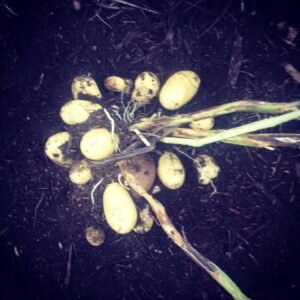
Some of my potatoes one year
Potatoes prefer a sunny, well-drained position and rich, fertile soil. Try not to plant them in the same spot where potatoes, tomatoes, capsicums or eggplants have been grown recently, as they are all in the same family. Ideally, rotate that area for around three years.
In cooler climates, potatoes are often planted 2–3 weeks before the last frost. In Ipswich, we don’t usually have to work around heavy frost, so I tend to plant mine in June/July when the weather is cooler.
Seed potatoes are best planted once they have short shoots around 1cm long. If you buy your seed potatoes in May or June, this usually takes about four weeks.
Large seed potatoes can be cut into two, three or four pieces, as long as each piece has a good eye or shoot. The cut surface should be left to dry for a couple of days before planting. Personally, I don’t usually cut mine, as I haven’t had as much success with pre-cut potatoes.
The principle for growing potatoes is the same whether you grow them in the ground or in pots.
Potatoes in the Ground
1. Plant certified seed potatoes into shallow trenches in loose, free-draining soil. I like to use good quality compost with some sugar cane mulch mixed through, so the soil stays open rather than heavy and compacted.
As the plants grow, keep adding soil or compost around the stems until the mound is roughly 20cm above the original soil level. This is called hilling. Potatoes form close to the surface, so covering them helps stop them being exposed to light and turning green. Green potatoes can upset the stomach, so they are best avoided. Hilling can also encourage a better harvest.
2. Harvest when the lower leaves start to yellow. You can gently dig around and harvest only what you need, leaving the rest of the plant to keep growing. If you want to harvest and store the crop, cut the tops off and leave the potatoes in the ground for another 2–3 weeks before digging.
I have had some potato plants that I harvested from continuously through the season, and others that I left to harvest all at once. In my experience, neither method affected the final result too much.
Dug potatoes should be kept in a cool dark spot.
Good luck and just think how amazed your friends will be when at your Summer pool party you have blue potato salad!
Some varieties of Potatoes Trevallan stocks
The last few years of increment weather around potato season has led to many varieties either being only available in small quantities or just not at all. This year we have a limited supply of Sebago, Dutch Cream and Desiree plus a few newer varieties
Sebago
A long to oval shaped all-rounder with white flesh and skin that’s common in supermarkets and green grocers around Australia. This potato is great for boiling, mash, roasting, baking, chips and mash.
Dutch Cream
Dutch Cream, from Holland, are perfect for frying or serving cold in a salad. Their creamy flavour means they are one of the few waxy varieties that work in a mash as well.
Nicola
Nicola have a low GI rating, with a yellow buttery flesh. They are a firm potato and will hold its shape after boiling, making it perfect for salads. They make a dense creamy mash and good roasted if you part boil; as this will make them crisp up easier.
Kennebec
An old-fashioned variety that has been in Australia for many years. It’s origin from the USA. Loves to be Baked, Roasted or Fried. Have heard its great for the BBQ or pizzas.
Desiree
Red-skinned, yellow flesh with a distinctive flavour. Originally bred in the Netherlands in 1962. Has great resistance to drought, and is fairly resistant to disease. Best used for roasting, baking, and boiling
Pontiac
A very reliable all-rounder with pink skin and white flesh. Great to boil, bake, roast, microwave and mash but not so suitable for frying.
Kipfler
A waxy, finger-shaped, knobbly potato with yellow skin and a light yellow flesh with a buttery nutty taste that is great boiled, steamed, in salads and roasted but not recommended for frying or chips.
Salad Rose
Features a red skin with yellow flesh. Salad Rose is excellent for salads, steaming, boiling, roasting and mashing. Very good for Soups and stews as it won't break apart once cooked.
Sapphire
Has unusual purple skin and flesh. Like all darker coloured veggies Sapphire is packed full of antioxidants. The colour is maintained even after cooking. Great all rounder potato, suitable for salads, boiling, mashing, roasting and chips.
Avanti
An early white potato bred in the Netherlands. A good all-rounder for boiling, roasting and chips.
Delaware
An Australian-bred variety known for reliable crops. Great boiled, steamed, roasted or used in salads.
Imperial Blue
An Australian-bred gourmet potato with striking purple-blue skin and flesh. Beautiful roasted, as wedges or in colourful salads.
Red Lady
A smooth red-skinned potato with creamy flesh. A lovely all-rounder for roasting, baking, boiling and warm winter dishes.
Rodeo
A reliable variety with creamy flesh and good storage qualities. Useful for roasting, baking and mashing.

Planting Sweet Peas
Sweet Peas are a fragrant spring flowering annual, native to Italy. They have one of the most enchanting flowers, delicate and fragrant, perfect in garden or admired in a vase. Learn how to grow Sweet Peas in Ipswich.
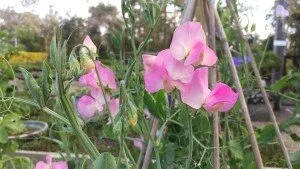
Sweet pea flowers from The Mountain Man
Sweet Peas are a fragrant spring flowering annual, native to Italy. They have one of the most enchanting flowers, delicate and fragrant, perfect in garden or admired in a vase.
Tradition dictates that March 17th (St Patrick's day) is the time to plant Sweet pea seeds. Have you ever wondered why?
Planting PEA seeds on St Patrick's Day is an old American tradition. As you will need the 'luck of the Irish' to get plants to grow while there is still snow on the ground!!!
For us here in Australia, we still follow this tradition because lets be honest here in Ipswich we need the 'luck of the Irish' to get sweet peas flowering and looking good. Normally, March is still too warm to start our winter gardens here in SE QLD.
Instead I use time as a reminder to prepare my soil.
Noel Burdette used to live here in the Ipswich region. Years ago he offered me this great advice about preparing the soil for Sweet Peas. This information is for sweet peas but can be applied to any peas.
Noel's Sweet Pea Advice
Sweet peas like a full sun position in the garden with plenty of airflow to minimise any fungal concerns.
They also enjoy a slightly higher level of pH in the soil, somewhere between 7.5 - 8.5. You can adjust your pH by applying a generous amount of Dolomite (provide much needed Magnesium) or a light dusting of Lime (as the calcium content is important).
They love well composted soil. We use Searles Compost but a little well aged sheep, cow or chicken manure worked into the soil would also help to encourage good drainage, yet adequate moisture retention.
Usually around mid April is a good time to plant out your seeds or the first quarter moon after St Patricks Day. Noel recommends to soak them overnight in a little water with a small amount of Condi's crystals (usually get this at a chemist) as this will encourage a higher percentage of germination.
After planting the seeds in the ground, water them in once and don't water again until they are "up and out "of the ground.
Pinch out any lateral growth in the early stages as what you're looking for are strong, upright plants that will then branch out as they get older and provide long lasting, fragrant blooms from late winter and into spring.
Fertilise your Sweet Peas with Organic Link when first growth appears and then alternating fortnightly between Triple Boost and Silica and Potash Liquid fertiliser.
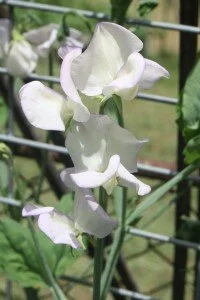
Sweet Pea Fragrant spring flowering annual, used as cut flower, native to Italy
All sweet peas are climbing. Some are dwarf climbers (only grow to about 50cm) and others can grow to over 2m.
With all types of sweet peas, ensure they have somewhere to stretch their tendrils (fences or tepees) or maybe try them in a hanging basket and let the tendrils hang down.
Trevallan stocks Eden Seeds (non-hybrid open pollinated old fashioned seeds) Sweet Peas and Pohlmans Sweet Pea Seedlings. This year we have two choices in the seeds and the seedlings. The seedlings aren't usually available until April.
Bijou, Dwarf (seeds and seedlings)
Early Gigantea, mixed colours to 3m high, early flowering (seedlings only)
Spencer Choice Mix, The classic English sweetpea, 1902 release developed from Earl of Spencer's garden, climbing (seeds only)
Come into Trevallan and we can help you on your Pea Journey. Good Luck.

Why you don't grow food from scraps!
I know the current trend is growing fruit and vegetables from scraps. I would never recommend growing anything from scraps or seeds from fruit and vegetables you buy from the shops. .
I know the current trend is growing fruit and vegetables from scraps. However, I would never recommend growing anything from scraps or seeds from fruit and vegetables you buy from the shops. .
Why? Well, firstly, most of the fruit you buy from the shops, even if it is organic, has been hybridised. As a result, the seeds you put in may be nothing like the vegetable you took it out of.
Secondly, a lot of fruit and vegetables nowadays have seeds in them that are sterile, which means the seeds will not usually grow. If they do , it will only be for a short period of time and they’ll usually wither out and die before anything happens, or will be very prone to insects and disease.

Thirdly, and in my eyes the most important reason why you shouldn’t grow from your scraps, is some vegetables, like potato tubers, can carry many bacterial, viral, and fungal diseases. These bacterial, viral, and fungal diseases are easily passed onto other plants and as a result, can contaminate the soil and make an area implantable. The infections in potatoes can not only affect your potato plants, but also have an impact on all plants in the potato family, such as tomatoes, eggplants and chillies.
I don't believe planting from scraps saves me time or money, in fact, I honestly believe it costs me time and money. This is why I try to always use vegetable seeds that are non-hybrid and open pollinated, like Eden Seeds, and I ALWAYS buy new certified organic potato seed.
Trevallan Lifestyle Centre stocks a wide range of Eden Seeds, which are non-hybrid, old traditional, open pollinated varieties of seeds, with no chemical treatment or genetic modification.

Growing Spring Flowering Bulbs in South East Queensland
Spring Flowering Bulbs in South East Queensland seem like a waste of time, don’t despair though we can still plant some beautiful bulbs, corms, and tubers, we just need to change what we plant!

Ranunculus flowers almost look too good to be real. These are an easy to grow Spring Bulb
Bulbs, corms and tubers are all sometimes erroneously referred to as bulbs. The technical term for plants that form underground storage organs is geophyte. All these types of plants cycle through vegetative and reproductive growth stages; the bulb grows to flowering size during the vegetative stage and the plant flowers during the reproductive stage.
These plants need certain conditions to trigger the transition from one stage to the next, such as the shift from a cold winter to warm spring.
Due to the bulb, corm or tuber being a storage device, these plants can also survive adverse conditions such as cold, excessive heat, lack of light or drought.
The foliage of these plants absorb nutrients from the soil and energy from the sun for setting flowers for the next year. After the foliage period is complete, bulbs can be dug up for replanting elsewhere.
I just love the idea of my garden bursting with colour and scent in the Spring, like they do down south or overseas, but sadly, Spring flowering bulbs in South East Queensland just don’t really live up to the expectation.

Hippeastrum reticulatum var. striatifolium
Don’t despair though, we can still plant some beautiful bulbs, corms, and tubers, we just have to accept that our choices are different to the southern states. We can still grow tulips, hyacinths, daffodils, ranunculus and anemone here in South East Queensland. It's just they will never grow like they do down south or in Europe. They usually only flower for just one season and we treat them the same as other flowering annuals such as marigolds, pansies or petunias.
If you want bulbs that will naturalise and come up year after year in your garden and pots, you can happily choose bulbs such as Freesias, Ixia, Sparaxis, Jonquils, Babiana, Tritonia, Leucojum aestivum, Eucharis, Sprekelia, Zephyranthes, Rex Begionas or Proiphys cunninghamii (Brisbane Lily). Don't forget we also have some great summer bulbs/corms/tubers like Hippeastrums, Scadoxus, Haemanthus, Caladiums and ornamental Gingers. We are slowly building up our bulb collection here at Trevallan… SHOP BULBS HERE
When I am looking for new bulbs to plant out, I like to look for flowering bulbs native to South Africa, as I find these do a lot better in South East Queensland.
In my quest to achieve a garden that comes alive with flowering bulbs, I asked Claire Bickle from Gardening for the GoodLife to give me a few tips on how to achieve this daunting task!
Claire Bickle's Tips for Growing Bulbs
Place larger bulbs, such as jonquils, hyacinths, daffodils and tulips in a paper bag in the crisper drawer of the fridge for 4-6 weeks before planting. This gives them the chill down they would not otherwise receive in our mild autumns.
Ranunculus corms are best spread out on a thick wad of wet newspaper and covered with another reasonably damp wad overnight before planting the next day. This helps the corms to swell and get ready for shooting once planted.
If growing in pots, use a good quality potting mix and ensure the pots have good drainage. Shallow pots work quite well too and remember some bulbs can be planted closely together.
You can fertilise the soil with Organic Link when planting, but there is no need to start fertilising with liquid fertiliser until they have some growth. Then I alternate fortnightly feeds between Triple Boost and Potash and Silica.
When the bulbs have finished flowering, don’t be tempted to cut all the foliage off. Leave it to die down naturally, as this is how the bulb draws back in all it’s nutrients to store away until the next season.

A range of spring flowering bulbs
I am very excited, the bulb garden of my dreams may just be achievable if I change the way I view my end goal. This year I've bought myself a mixture of bulbs like Gladiolus, Iris, Jonquils and Ranunculus and I have interplanted them amongst my annuals like poppies, pansies and lobelia. I can't wait to try out Claire's tips and see what comes up this and hopefully, next year. One thing about gardening which is for sure though is that it's never the same!

Is Green Manure just really Green Poo?
Green manure crops are crops grown not to be harvested but instead to be incorporated into the soil before they reach maturity to contribute to the health of the soil.
Wonderful blistering hot days, humidity that feels like we should be living in tropics, rain and winds that blow your roof off then cool days that make us wonder if that 45 degree day was just in our imagination.
This is what it can feel like to live in Ipswich in the summer.
How would you fare in this weather? Hot, bothered, quick tempered?
I know I've been struggling, the smallest things bother me.
If I had a vegetable patch right now, I know I'd be pulling most of it up.
If the heat didn't kill everything off, the humidity or insects probably would have.
In years past when I have had a vegetable patch in summer I have suffered with burnt leaves, white mould all over my cucumbers, tomato blight and then to top it all off grubs in my fruit (from fruit fly stings).
Which is why now, at this time of year I always sow a summer green manure crop.
Green manure crops are crops grown not to be harvested but instead to be incorporated into the soil before they reach maturity to contribute to the health of the soil.
It is an old technique of soil management that seems to have been forgotten by many gardeners and farmers. I think it's because we are no longer aware of the proven benefits and cost effectiveness of green manure crops.
Trevallan Lifestyle Centre stocks Eden Seeds, a seed company that only stocks old traditional open pollinated varieties of seed, preferably old Australian varieties and organically or bio-dynamically grown where possible. Eden Seeds do a wonderful green manure seed pack that contains a mix of seeds suited to most climates.
Green manure crops contribute directly to the fertility of your vegetable patch through the supply of important plant nutrients. Legumes, for instance, supply nitrogen because their roots form an association with soil-borne bacteria that can transform nitrogen from the atmosphere into nitrogen compounds that can be used by plants. Isn't nature wonderful? It's also just saved you money as now you don't need to add as much fertiliser to your vegetable patch.
Green manure crops can also contribute indirectly to nutrient supply. Just the process of decomposition of the crop aids in making further nutrients available that are already present in the soil but in a form that cannot be used by plants. After the plants have grown and you incorporate them back into the soil you are supplying vast amounts of organic matter that is usually supplied by organic mulches. Once again saving you money - no need to buy organic mulch.
Drought resistance can also be improved as a lot of the crops are very deep rooted. Their roots can penetrate the subsoil and open it up. Next season's crops can also obtain plant nutrients from the subsoil once it is opened by deep rooted green manure crops.
So this weekend get dirty and take out all your hot weather anger on your vegetable patch by pulling everything up and planting some green manure crops. Your winter vegetables will thank you.