Find Us:
77 Fernvale Rd
Brassall QLD 4305
(07) 3201 8630
Open:
Tue-Sun 9am - 4pm

Going Potty
Best Practices for having a Potted Garden
I always get asked what’s the best pot and potting mix to use.
For Pots, personally I love terracotta. It’s classic and classy.
Yes, terracotta is pourous but it also breathes and that is fantastic. No, I don’t seal the inside of my pots I love the aged look of terracotta.
I find when you have a 45°C everything drys out no matter what pot you use.
I personally don’t like decorative plastic pots. I have found in the past that plants root balls sweat in these pots and I get very ill looking plants in summer.
I always use Searles Garden Products Platinum Mix in my pots and I always mulch my pots. I fertilise them with Organic Link by Plant of Health Eco Friendly Fertilisers every three months. I try to liquid fertilise fortnight with Triple Boost but to be honest I do forget!
I love grouping pots together. The trick to this is always using the same colour.
So if you use terracotta, find terracotta pots in all different shapes and sizes. Same goes for glazed pots, try to find a similar colour but group all different sizes and styles together. I love the eclectic look but I’d rather the plants do the talking not the pots.
If you have all your plants still in the coloured plastic pots that you get your plants in, try changing them all to Black. Black plastic pots are available in every size imaginable, even huge! It’s a simple and cost effective way of making a statement.
Pots can be used in the garden or around the house. I love using pots in the garden, perfect for those spaces when I can’t dig due to roots or I need height but don’t want to put in a large plant.
I love that with pots you can constantly change your look just by having a little rearrange.
The Great Potting Mix Debate
So often customers come in and tell me their woeful potting mix stories. They tell me how they make their own with really bad quality products or worse how they use garden soil in pots .

I know I am lucky. I need potting mix, I just walk to the shelf, grab the best one and use it.
It hasn’t always been like that.
Years ago I lived away from Trevallan and there were many times I did some gardening and ran out of potting mix. I’d shoot up the street and buy whatever cheap stuff they had. It was just to finish off a job. I didn’t care.
Well I should have because that potting mix ruined my plants. For next six months or so I’d be watering and fertilising and wondering where the hell I went wrong and then I remembered the cheap potting mix. I spent more money trying to keep my plants alive than I would have spent with the expensive potting mix. I eventually repotted into the good stuff and everything grew beautifully.
There is a VAST difference in potting mixes and brands on market. The $2 bag is never ever going to be as good as the $16 unless you add $20 worth of product to it.
So always, always buy the superior product.
Companies spend millions of dollars researching potting mix and how to make it better for you. Trust they know what they are doing and use their superior brands.
If you want to make your own, excellent, make sure you research it well and always use superior products to make your own potting mix.
Garden soil is not for pots, EVER! It’s too heavy. It will either stay too wet and end up being a rotting gluggy mess or will go rock hard.
If your pots dry out too quickly try using a better quality mix and mulch and soil wetter regularly.
All my pots are mulched (I use sugar cane), it makes a huge difference to dry out rates. I also soil wet my pots every six months or so.
I personally use and recommend Searles Garden Products top potting mix - Platinum potting mix. Some of my customers find it keeps their plants too wet so they use the next potting mix down Professional potting mix.
Don’t cut any corners with soil. Soil is the starting point from where your plants grow and thrive
Planting edibles and flowers in POTS hot tips

Use the best quality potting mix. If you have a favourite brand research and find that company’s best quality potting mix.
Go big. Don’t muck around with 20 small pots. I know you’ve seen you can plant your chives into an old kettle but don’t do it. When doing edibles always start at 30cm or bigger. You can put your chives and basil and parsley in a one big pot but don’t go small. Firstly lots of Small pots looks ugly. Secondly too small pots dry out quicker.
Fertilise with Organic Link, as soon as you pot. Yes, I know that bag of potting mix said 12 months feeding but it could have been sitting out in the hot weather for 12 months. So just fertilise with the best organic fertiliser you can get your hands on and then you know when it was fertilised last and you can then refeed in about three months time.
Mulch, yes I mulch my pots. Yes it makes a huge difference. No it doesn’t matter what you use. Apart from stones. Stones are not mulch. Stones are decoration. Use sugarcane mulch or something else that will break down into the soil over time.
Put in sun. Most edibles need at least 4 hours of sun
Water as needed. Probably at least every second or third day. Maybe more as it gets warmer.
I hear you screaming in background but you have possums and wildlife and children that will wreck this potted garden on you. Solution and best ever invention. Buy a Vegepod
These pods come with their own wicking bed, irrigation system and wildlife cover. They are flamin’ fantastic.

Vegetable Garden Checklist
Quick guide to creating your own vegetable garden and growing your own food
✔ Choose a position that receives 5-6 hours sun per day.
✔ Remove the existing grass, plants, rubble.
✔ Add Organic Matter, water in well.
Organic Matter is compost, soil activator, animal manure, fertiliser manure pellets, blood and bone. If you have very clay soil add some liquid gypsum
✔Make sure ground is well tilled to at least 30cm, preferably 60cm.
✔ Choose vegetable seedlings that are appropriate for the season and Plant (roots side down 😉)!
Plant a diversity of flowers, herbs and vegetables so your garden attracts beneficial insects. Here is a great list of Cool Season Vegetables
✔After planting Water all in well with Triple Boost as this helps reduce transplant shock.
✔ Mulch with an organic mulch like sugarcane or lucerne. Water again.
Mulch helps to conserve soil moisture, suppress weeds, keep the soil an even temperature and stop erosion. If directly sowing seeds only use a very fine layer of mulch so as to not impede seed germination.
✔ Water regularly
✔ Fertilise with a combination of Triple Boost Fruit and Vegetable and Neem Liquid Fertiliser fortnightly .... Enjoy!

Winter Vegetables
Autumn, Warm Days, cool nights. Perfect for vegetable planting.
Autumn. Warm Days, cool nights. Perfect for vegetable planting.
By now your vegetable patch has been freshly composted and manured. It’s just waiting for you to plant out. If you are having trouble with how to start off your vegetable patch, check out my Vegetable Patch Checklist
The basic cool season vegetables that I find grow well in most areas are – broccoli, beetroot (my favourite), cabbage, cauliflower, leek, onions, shallots, silverbeet, spinach, snow peas, strawberries (my other favourite), peas, kale and rhubarb.
If you don’t get a frost or you can cover your vegetables - beans, lettuce, capsicum and tomatoes can also be grown.
If you get really cold you can give brussels sprouts a go.
This is the basic vegetable range; there are so many different variations on these classic cooler weather vegetables.

In seedlings alone you can get about four different versions of broccoli.
If you start using old fashioned open pollinated seeds, the list can be endless.
If your vegetable patch consists of a variety of different sized pots don’t worry, there is a large range of dwarf vegetables available in seedlings and seeds.
Leek, lettuce, capsicums, shallots, silverbeet, spinach, snow peas, strawberries, peas and rhubarb all grow well in pots without needing dwarf varieties.
The secret to growing any vegetables in pots follows the same principles as growing in the ground.
Start with the best quality soil or potting mix, mulch with an organic material (I like organic sugar cane mulch that is free from weeds), fertilise with a complete organic slow release fertiliser and liquid fertilise fortnightly with a complete organic liquid fertiliser.
I like using the Plant of Health range of fertilisers – Organic Link and Triple Boost and Searles' range of garden soil for gardens and potting mix - Platinum Potting Mix for pots
I find the cooler months are the best time for growing herbs. Nearly all the herbs are available now. Herbs grow well in the garden or in pots and most herbs can be grouped together in pots to make mini herb gardens.
The best thing about growing cool season vegetables is that it’s usually too cold for the pests to be out and about. If you do get a few pests a pyrethrum based spray or one of the new organic sprays like eco oil or eco fend work well. Mildew and mould is a common problem during wet winters - copper spray (some are considered organic) can be the best solution.
I have heard that having pretend white butterflies in your vegetable patch not only looks pretty but helps deter moths. Jerry Coleby-Williams has also mentioned that Land Cress is a confirmed biocontrol. We stock Land cress in seeds and in plants.
Remember though the healthier the soil, the healthier the plants and the less likely you are to get problems. Now get outside and get dirty!

Bloomin' Fabulous
Potassium Sulphate or Sulphate of Potash is commonly called Potash. It is an essential element necessary to the lives of all plants.
A common question I am asked is "why didn't my fruit trees fruit profusely or if they did why was the fruit misshapen?" Or "why didn't my camellias and azaleas flower as well this year?" Or even "why are all my coloured foliaged plants like crotons and dracaenas losing their colour?"
The answer is usually quite simple - Your garden just needs some TLC and maybe a little Potash!
Potassium Sulphate or Sulphate of Potash is commonly called Potash. It is an essential element necessary to the lives of all plants.
It aids in disease resistance and frost protection by strengthening the plants cell walls. It helps in seed and root development. It encourages strong new growth and helps with the formation of flower buds and fruit.
Potash can improve the quality and the colour of flowers and enhances the formation of proteins and sugars in fruit. Potash can even help plants with slender stems and large flower heads such as Iceland poppies and gerberas hold their heads erect.
Potash defective cues can be seen in a number of ways in your plant. Your plants might be showing signs of overall weakness especially in its stem. It could have yellowing leaf margins and grow more slowly. It could also be disease prone and its fruit and flowers will be small and poorly coloured and sometimes tasteless.
Don't confuse a potash deficiency though with an unhealthy plant. Always make sure you have given your plant some complete slow release organic fertiliser like Organic Link and a Bio Trace first.
Complete fertilisers, whether they are chemical or organic, usually contain potash. Organic Link contains potash. An N:P:K ratio can usually be found on the fertiliser label. A very quick explanation of the N:P:K ratio is - N stands for Nitrogen (greening, growing), P Phosphorus (roots) and K Potassium (fruiting, flowering).
If you use mainly a manure based fertiliser like blood and bone or chicken manure you will need to add potash as these products don’t naturally contain it.
Potash also is available by itself in a liquid form and a granular form.
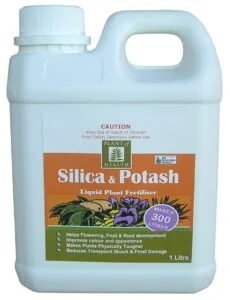
The liquid form is added to water and used as a foliar spray. Used like this it is quick acting but not long lasting and needs to be repeated on a fortnightly basis. This is best for promoting flowers especially on annuals. I use Plant of Health's Potash and Silica.
The granular form is added to the soil and watered in. The granular is slower acting but lasts a lot longer. This is best for correcting deficiencies, promoting fruit and stimulating coloured foliage. We use Searles' Potash.
This weekend I want you all to get some granular potash and go a little silly in your gardens.