Find Us:
77 Fernvale Rd
Brassall QLD 4305
(07) 3201 8630
Open:
Tue-Sun 9am - 4pm
Shiny, Dead, and Overpriced
This blog dives into how we've been sold the idea that "clean" and "premium" means better but when it comes to honey, coconut oil, and fertilisers, the truth is often the opposite. Learn how processing strips products of their life, and why real change starts at the checkout.
Today I found out something that honestly blew my mind.
People still buy honey from the supermarket and have no idea that it’s fake! Somehow, we’ve normalised honey that stays perfectly liquid forever. We’ve been sold the idea that clear liquid honey is better, when in reality, it often just means overly processed, lifeless, and ineffective.
This rabbit hole doesn’t stop with honey. It runs deep through our pantries, our skincare routines, and even our gardens.
Crystallisation is Life
Real, raw honey crystallises. It’s supposed to. That process is natural, a sign of the presence of glucose and trace particles like pollen that trigger crystallisation. Supermarket honey doesn’t crystallise because it’s been aggressively processed to improve its shelf appeal and extend its use-by date.
That usually means:
Heat treatment (pasteurisation) - heating honey to around 60–70°C breaks down crystals and slows crystallisation, but it also destroys the natural enzymes (like diastase, invertase, and glucose oxidase), which are responsible for its antibacterial, antioxidant, and digestive properties.
Ultrafiltration - this removes not only particles like wax and pollen (which are natural indicators of origin and quality), but also strips away much of the honey’s flavour complexity, nutrient density, and trace minerals.
Blending from multiple, often international sources - most commercial honey isn’t single-origin. It’s pooled from various suppliers, sometimes across countries, to create a uniform, supermarket-friendly product. This means you have no real idea where your honey comes from, how it was produced, or what standards it was held to.
What you’re left with is honey that looks “clean” and pours neatly but is void of life. No active enzymes, beneficial microbes and worse no subtle floral signatures from the plants the bees foraged.
It’s essentially just sugar syrup with a great marketing spin.
Real honey, raw and unfiltered, varies in colour and flavour with the flowers of the season, and yes, it crystallises over time. That crystallisation isn’t a flaw. It’s a feature. It tells you that the honey still contains all its natural compounds, just as the bees made it.
Want to go deeper into what real honey is (and isn’t)? Read my full honey blog here
Fractionated Means Stripped Bare
Next stop on the deception train: coconut oil.
You might see “fractionated coconut oil” sold at premium prices. Some companies even market it as better than real coconut oil, thanks to its “feather-light emollient effect” and “Certified Pure Tested Grade™” status.
Sounds fancy, right?
But fractionated coconut oil is just coconut oil that’s been processed to remove the fatty acids that give it any real benefit, especially lauric acid, which is what gives virgin coconut oil its antibacterial, antiviral power.
It’s clear, it doesn’t solidify and it looks “pure” but to get to that point, it lost everything that made it good.
So while it’s stable and neat and won’t harden in the cupboard… it’s also nutritionally meaningless.
Fertiliser Fakery: When “Organic” Isn’t Alive
And then we get to the garden aisle.
Everyone wants organic fertiliser these days. Pelletised, easy to apply, no smell, no mess. Sounds ideal, right? There’s a problem with that, most pelletised organic fertilisers are made using high heat extrusion.
That means they’ve been cooked at temperatures that:
Destroy microbial life
Break down beneficial compounds like humic and fulvic acids
Leave you with pellets that do very little for the soil
So you’re spending money on “organic” fertiliser that’s just dead bulk.
Organic Link I have found is one exception. Instead of heat, they use low-temperature dehydration to form their pellets. This method retains soil-loving microorganisms, active humic substances and actual organic nutrients that actually feed your soil
Destroying Life for Aesthetics
I wish my daughter came up with this catch phrase, but she didn’t. We are living in a culture that promotes clear and beautiful over real and healthier. We’ve been trained to value appearance, convenience, clarity, and neatness over substance, integrity, and function.
Let’s be honest, most products on our shelves have been overly processed, stripped, sterilised, and deactivated, all in the name of shelf life, marketing, “premium” appeal and profit. These products have lost their soul, and I feel so are we by allowing this to happen. Normalising this.
Can we all just take a moment… and think?
Seriously. Use our brains.
Corporations aren’t here to save us. Capilano isn’t here to give us real honey. No one is offering us real food anymore. And let’s be honest, our government is doing nothing to protect the farmers who actually feed us.
So let’s start a movement. Let’s start with honey.
Stop buying the supermarket stuff, I don’t care how fancy the label looks. Buy from a local beekeeper. Ask where it came from. Learn what real honey tastes like. And once you’ve made that switch, let’s talk about eggs. Then meat. Then the rest.
Because change doesn’t come from the top. It starts at the checkout.
“If you think you’re too small to make a difference, you haven’t spent the night with a mosquito.” African proverb
Real consumers ask questions.
So let’s start asking them and let’s start now.

Lemon Balm
Melissa is the Greek word for "honey-bee." It was traditionally used by the ancient bee keepers. They used to rub the crushed leaves on the beehives to encourage the domesticated bees to return to their hives. They also believed that the lemon balm would also bring new bees to the hive.
The most amazing thing happened to me yesterday. I was admiring our beautiful Lemon Balm (Melissa officinalis) and I gently agitated the foliage. The scent that was released was so delicious and soft but with such a strong bite I just had to do it again.
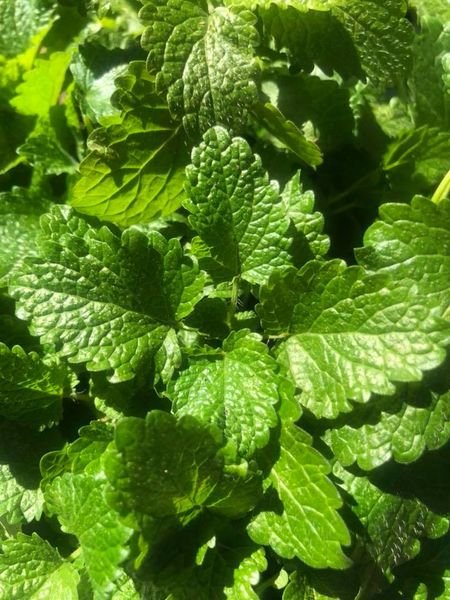
As I leant my hand down to swish the foliage I saw about six European bees and a number of native bees swarming the foliage looking for nectar.
It was like the scent of just the foliage alone (no flowers) sent out a calling card to all the nearby bees.
Here’s where the story gets even cooler.
Melissa is the Greek word for "honey-bee." It was traditionally used by the ancient bee keepers. They used to rub the crushed leaves on the beehives to encourage the domesticated bees to return to their hives. They also believed that the lemon balm would also bring new bees to the hive.
How cool is that.
I love how random bits of information make sense.
Melissa naturally occurs throughout Europe to central Asia. It is widely cultivated today for its essential oil, practical herbal uses and as a great bedding plant.

Lemon Balm is a lemon-scented perennial with a 4-angled stem and ovate, toothed dark green leaves. It likes to grow in moist soil in the sun or partial shade. It provides a nice thick ground cover. It can grow well in a pot (we have ours growing in an old saucepan), hanging baskets or the garden.
After flowering it is recommended to prune back to produce a fresh crop of leaves.
There are so many uses for lemon balm and I think I am going to have to see if I can get this plant growing at home.
Dried leaves can be added to potpourri and herb pillows.
You can use it in cooking – soups, salads, flavoured oils, sauces.
You can use it to make a tea to help with nervous disorders, indigestion associated with nervous tension, depression, anxiety, gout.
It can also be rubbed fresh onto the skin as an insect repellent and to soothe insect bites.
Lemon Balm essential oil is one of my favourite oils and is also very precious and very expensive. So I have to be careful not to use it in every blend I make.
It has been said that it is the ruler of the brain, strengthening memory and removing melancholy. Fischer-Rizzi said it helps us find inner contentment and strengthens ‘wisdom of the heart’. It is one of the best essential oils to help with down in dumps can’t move depression.
I was in love with this herb just from its scent.
Now I know no garden should exist without it!
Go find some lemon balm and lift your spirits and give your heart some contentment.

Native Daisy
Brachyscome multifida is endemic to Australia and a brilliant free flowering hardy ground cover daisy. This cute little daisy has fine feathery foliage and can grow to about 50cm diameter and about 40cm high.

Brachyscome multifida is endemic to Australia and a brilliant free flowering hardy ground cover daisy.
This cute little daisy has fine feathery foliage and can grow to about 50cm diameter and about 40cm high.
It prefers full sun in good quality free draining soil. The flowers usually appear from mid winter until summer but they can spot flower continuously if conditions are right. The flowers are usually shades of pinks and purples.
They don’t mind the cold or a little bit of dry but do need a top up water.
Fertilise then seasonally with a good quality complete organic fertiliser like Organic Link. They also appreciate a liquid fertilise with Triple Boost to keep them powering on.
I think these guys make great fillers in gardens and work like a living mulch. I also have seen them tumbling out of urns and as hanging basket specimens for full sun areas.

I think these guys are really cute and would work well in a cottage or formal landscape. Sometimes we all need a daisy in our lives.

My Flowers bring all the Bees to the Yard
Here are a list of some of my favourite bee attracting plants. When I say bee I mean all bees. Some plants will attract European bees and some will attract native bees. I don’t discriminate, I love them all and want all of them visiting my garden! This list is not exhaustive it’s just a list to get you started.
Question
I would love some suggestions for bee attracting plants that will be happy in clay soil and Ipswich climate. We have plenty in flower at the moment (mostly bottle brush and lillipilli) but would love some suggestions for other times of the year. We do have some citrus which flower periodically too.
Trevallan’s Answer

Clay soils can be a problem for many plants. I do always suggest your cultivate your soil as much as possible with compost, Searles Soil Activator and/or Plant of Health’s Liquid Soil Microbes. Always use an organic mulch like sugarcane or tea tree as the more it breaks down the better the soil becomes. Always use organic fertilises like Organic Link or Pelletised Five In One.
Switch to organic pesticides.
There are some plants that just won’t grow for us in the ground and that’s ok. Use groups of large pots in the garden. I love placing pots around in my garden, it gives the garden another dimension and it allows me to have things I may not be able to grow if it was growing in garden soil. Hanging baskets are another great way to add a new dimension to your garden. You don’t have to hang hanging baskets on your patio .... use large tree branches and hang them in your garden.
Also it’s a great idea to have shallow water dishes around the garden so the bees can rehydrate. Yes, you have to fill them regularly in the heat but the little things we do for wildlife goes a long way and they will repay you by pollinating your vegetables and fruit!
Some of the mentioned plants are seasonal and some are forever. Some will grow better in part sun and some can handle all day sun. Some are trees, some are small. All will grow in Ipswich.
So here are a list of some of my favourite bee attracting plants. When I say bee I mean all bees. Some plants will attract European bees and some will attract native bees. I don’t discriminate, I love them all and want all of them visiting my garden! This list is not exhaustive it’s just a list to get you started.
Bacopa
Camellia Sasanqua
Grevilleas
Lavenders
Fruit trees
Salvia
Daisies
Buddleja
roses
Penstemon
sunflower
marigold
Dandelion
Calendula
Pentas
African Blue Basil
Most herbs left to flower
Alyssum
Murraya paniculata
Jasmine
Aster
cosmos
Lemon Balm (Melissa officinalis)
Borage
Native hibiscus (Alyogyne huegelii)
Guava
Macadamia
Backhousia citriodora
Eucalyptus
Strawberries
Blueberries
Any Syzygium but my favourite is Cascade
Leptospermum
Callistemon
Westringia fruticosa
Waterhousea floribunda
Buckinghamia celsissima
And this list can go on and on.
I also have Eden Seeds bee flower seed mix, which is mixture of flowering plants. Cultivate soil, throw out seeds and see what comes up.
HAVE FUN
“If the bee disappeared off the surface of the globe, then man would have only four years of life left. No more bees, no more pollination, no more plants, no more animals, no more man.” Albert Einstein

Honey
Store bought honey is usually a combination of honeys from all different suppliers from all different regions, therefore all different flowers were used in the making of the money. Plus, the honey is also put through a refining process which some believe changes the structure of the honey.
We all know bees are crucial for pollination and food production, but there’s another incredible gift they give us: Honey.
I was lucky enough to grow up with grandparents and an uncle who kept beehives. Thanks to them, I learnt early on that bees weren’t something to fear, and that fresh honeycomb is one of life’s greatest gifts.
In fact, it wasn’t until I moved out of home and tried store-bought honey that I was genuinely surprised by what other people HAD to eat. Not only did it taste very different (like terrible), but it never crystallised. Not once.
If you've only ever had supermarket honey (even if it’s labelled ‘organic’), you might think honey is always a golden, runny liquid. But raw, real honey, the kind that comes straight from the hive, does crystallise, harden. And that’s completely normal.
Honey naturally contains two main sugars: glucose and fructose. The ratio of these sugars depends on the flowers the bees have been foraging on. The higher the glucose, the faster the honey will crystallise. Even though honey is low in water (usually under 18%), some of that water separates from the glucose over time. As glucose loses water, it starts to form crystals. Once one crystal forms, more will follow, and soon the whole jar of honey is set hard or crystallised. If there’s pollen, propolis, or wax in the honey, which there always is in raw, real, honey, these particles act as anchors that help crystals grow.
So if your honey goes hard or crystallised, that means you have real honey. If you want to return it to liquid form, just pop the jar in a sunny spot or sit it in warm (not boiling) water.
Why Doesn’t Store-Bought Honey Crystallise?
There are a few reasons. Most commercial honey is blended, meaning it’s mixed from multiple sources, usually from all over the world, usually from unspecified sources. It includes honey from bees feeding on a wide range of flowers, the glucose-to-fructose ratio becomes more balanced, slowing crystallisation. Blending also smooths out seasonal flavour changes, which might be good for consistency, but not for character. The biggest change happens during processing. Store-bought honey is ‘almost’ (always) heat-treated (pasteurised) and ultra-filtered. It’s heated to such high temperatures, usually between 60–70°C, that it dissolves any forming crystals and delays crystallisation.
This process comes at a cost.
Heating honey destroys many (all) of the natural enzymes, antioxidants, and aromatic compounds that give honey its character, complexity, and health benefits. The delicate floral notes disappear. The living goodness, like the antibacterial properties, immune support, and soothing effects, is gone. What’s left is a product that looks the part but lacks the soul.
In all cases, commercial honey is also diluted with glucose syrup or other sugar-based additives to bulk it out, which further reduces crystallisation and alters the taste.
The end result? A smooth, syrupy product that’s stable on the shelf but a far cry from what comes out of a hive.
Taste the Flowers
My grandfather’s honey never tasted the same twice. Each season, the flavour shifted with the flowers. When the tea trees (Leptospermum) were blooming, the honey was dark, bold, and almost medicinal (disgusting). When the ironbarks flowered, it became light, floral, and delicate (delectable).
As with most foods, unprocessed is best. Raw honey not only tastes better, but it also contains more beneficial enzymes, pollen, and antioxidants. Buying local honey from trusted beekeepers supports small producers and helps protect healthy bee populations in your area. So, please stop buying honey from the supermarket.
Now that you know what’s really in most supermarket Sugar Syrups, because let’s be honest, it’s not real honey, don’t pretend it’s the same thing. If it’s been heat-treated, filtered, blended, or cut with glucose syrup, it’s not real honey. It’s just a sweet imitation.
When you buy that kind of product, you’re not supporting beekeepers. You’re supporting a system that values shelf life and profitability over bee health and ultimately our health.
Choose better. Support real honey.

All about Bees
Bees pollinate over a third of the food we eat. Unfortunately, bee populations all over the world are declining which in turn is affecting the availability of our food.
Bees.
Just the word alone, can strike fear into some people. But did you know they are an essential element in the circle of life?
"If the bee disappeared off the surface of the globe, then man would only have four years of life left. No more bees, no more pollination, no more plants, no more animals, no more man." Albert Einstein
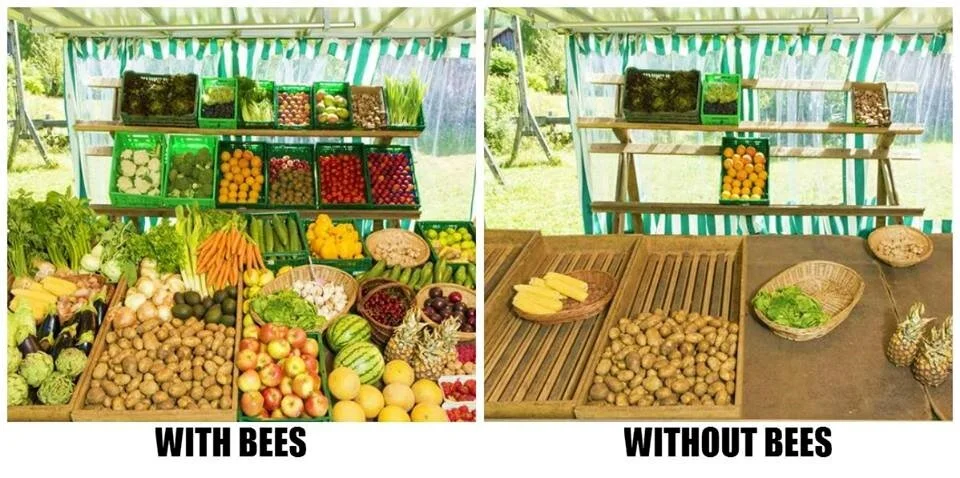
Bees pollinate over a third of the food we eat. Pollination is the process by which pollen is transferred in the reproduction of plants, thereby enabling fertilisation and reproduction, or in layman’s terms, bees help the flowers turn into food.
Unfortunately, bee populations all over the world are declining, which in turn is affecting the availability of our food.
The three main causes are believed to be Genetically Modified Crops (GMOS), chemical pesticide use and habitat loss.
Without getting into a huge debate on GM crops, it is believed one of the main reasons GM crops are leading to colony collapse is that the flower pollen on GM crops is sterile, thus causing the bees to become undernourished and die.
Bees generally travel as far as they need to get food. It is believed that the highest rate of return is between 6 to 7kms away from their hive. Therefore, if a hive is surrounded by GM crops the hive will die out.
The same goes for pesticides. If pesticides are being sprayed in an area, there is a high possibility that the bees will become infected and die out. Home gardeners should note that toxic pesticides meant to kill the bad bugs in our gardens can actually harm the bees which are so important to our environment and survival. Fortunately, Australia has banned many of these harmful pesticides in home use and luckily for us gardeners, there are alternatives. These alternatives are completely organic and don’t harm bees or any other good bugs, but do harm the bad bugs.
The third reason for decline is loss of habitat. This is brought about by development, abandoned farms, growing crops without leaving habitat for wildlife and growing gardens without flowers, or flowers that are not friendly to pollinators.

The larger honey bee (left) shown with the smaller stingless bee (right) on Citrus. Credit: (c) Tobias Smith
In Australia, we have some amazing native bees. There are over 1700 native bees and about ten species of small black stingless bees. They are only about 4 mm long, compared to 12 to 16mm long of the honey bee. The best thing about Australian native bees is that nearly everyone can have a hive or two in their yard.
Many years ago, I visited Melbourne and it seemed most of the suburban garden centres had a native bee hive in their centre. It was fantastic.
Why do we want a native bee hive in our yard?
Australian stingless native bees can be excellent pollinators of certain crops in Australia. They are particularly useful for macadamias, mangoes and watermelons. Also, they are not as prone to the colony collapse disorder that has decimated honeybee populations.
If we can increase the amount of Australian stingless native bees, we might be able to help reduce the loss of food production. Additionally, we might be able to assist the pollination chances in our fruit and vegetable patches.
Australian stingless native bees only produce small amounts of honey - less than one litre per year, particularly in warmer parts of Australia. However, it’s worth the effort as this honey (known as Sugarbag) is delicious.
Anyone can get a Native Bee Hive, as they don’t need as much attention as commercial honey bee hives and akin to the commercial honey bees, have an interesting social behaviour. Contrary to popular belief, you don't have to only have native flowers- I've seen Australian stingless native bees in a buzzing in a frenzy over camellia blooms. Furthermore, it’s worth knowing that increasing the number of Australian stingless native bees will NOT lead to a reduction in Honey bee population. The two can work in harmony.
If you’d like a hive go to the Australian Native Bee Association or Aussie Bee and see if there is a reseller near you. The ANBA promotes the conservation and sustainable use of all Australian native bees.
Do I have bees?
Take a walk around your garden early in the morning. Do you see any bees, native or European? What are they feeding on? I bet it’s not your beetroot leaves or agave leaves!
Growing your own vegetables is a brilliant idea, but don’t forget to mix it up and include some flowers in your edible garden! If you are completely against flowering plants, get some fruit trees, or let some of your vegetables go to flower or plant vegetables that flower, like pumpkin.
We all need to do our bit to keep the bees happy!