Find Us:
77 Fernvale Rd
Brassall QLD 4305
(07) 3201 8630
Open:
Tue-Sun 9am - 4pm

Time to Reconsider Coleus
Discover the beauty and resilience of Australia’s native Coleus and Plectranthus species. From the fragrant Plectranthus graveolens to the charming Cockatoo Bush, these tactile, aromatic plants bring depth, texture, and scent to any garden. Perfect for shaded, waterwise, and subtropical Australian landscapes.
Guest Post by Robert WilsonThe Case for Native Australian Species in Garden Design.
Love them or hate them, whether they are Coleus or Plectranthus, whether they feel nostalgic or a little bit "Granny garden", it’s time to take a fresh look at this diverse and under-appreciated genus.
Coleus has a broad distribution across Tropical and Sub-tropical regions of the world, but a special mention should be made for the charm, toughness, tactility and interest of our little native species (more on those later).
Let’s start with the familiar face: Coleus scutellarioides, the Painted Nettle. Spread throughout South East Asia and parts of Northern Australia, this is the garden variety we love (or don’t). It’s loud, it’s loveable(!) and when you look for it, it’s everywhere! Dayglo colours, wild leaf patterns, velvet textures, exotic leaf shapes. There is a cultivar to suit every palette. They are fun to collect, easy to propagate, accessible on any budget, and forgiving under most conditions. Garish or kitsch? Or A bold, herbaceous infill plant that emphasizes tropical plants with almost year round colour and interest! A winner in Brisbane, tolerates a range of conditions but for best colour, plant in dappled light and prevent flowering by dead-heading regularly. A minor few display good foliage colour in full sun (one of these is pictured). They can be standardized, pruned hard, plaited, heeled and generally forced into horticultural submission. For cheap, impactful, full, fast growing, tolerant, tough and vibrant bedding displays; get a hold of some “Painted Nettle” today!
I want to make a bigger case, one that speaks further to scent, texture, and mood in our gardens.
Australia’s native Coleus/Plectranthus species are not only beautiful: they’re powerfully sensory, and critically underused. Unlike their bright exotic cousins, native Coleus don’t shout. They enhance the pomp and circumstance of their big brothers and sisters in the garden. They support bold colour (or enhance earthen tones), radiate scent, and invite touch. They offer subtle leaf shapes, aromatic foliage, ease of maintenance, and floral displays that surprise in the dappled light. These aren’t feature plants; they’re the glue in a planting design. A skilfully selected and beautifully designed frame will enhance any artwork. They deserve far more love.
Let’s explore a few that bring scent, tone, and tactility into the spotlight:

Coleus argentatus (Silver Coleus)
This soft, silvery shrub shimmers in the shade. The foliage has a suede-like feel that begs to be touched, and its tall spikes of white, mauve, or soft blue flowers make it a beautiful alternative to lavender, especially in subtropical beds where lavender may fail. It’s cooling, calming, and quietly luminous. With its bright foliage and reliability in lower light conditions- perfect for brightening a shady or dull corner of the garden!

Coleus graveolens (Bush Basil)
A plant of surprising depth. Thick, textured leaves with a bright lime green tone and a strong, resinous aroma, somewhere between basil, mint, and native herbs. The foliage feels almost succulent under the fingers, while its purple-blue flowers rise up on soft stems. It brings density, texture, and fragrance to native garden designs. Large, intricately veined leaves provide the perfect foil to bold native wildflowers such as Grevillea or Hibiscus.

Plectranthus nitidus EN (Nightcap Plectranthus)
A small, endangered rainforest species that absolutely glows in low light. Glossy green leaves with maroon undersides and stems, a crisply toothed margin, and elegant leaf venation make it one of the most beautiful bedding plants for shady areas. Its flowers are like tiny chandeliers, twinkling purple and white across the understory. Want to see it? Gold Coast Regional Botanic Gardens has it planted in sweeps and mounds beneath rainforest trees; an absolute masterclass in subtle beauty.
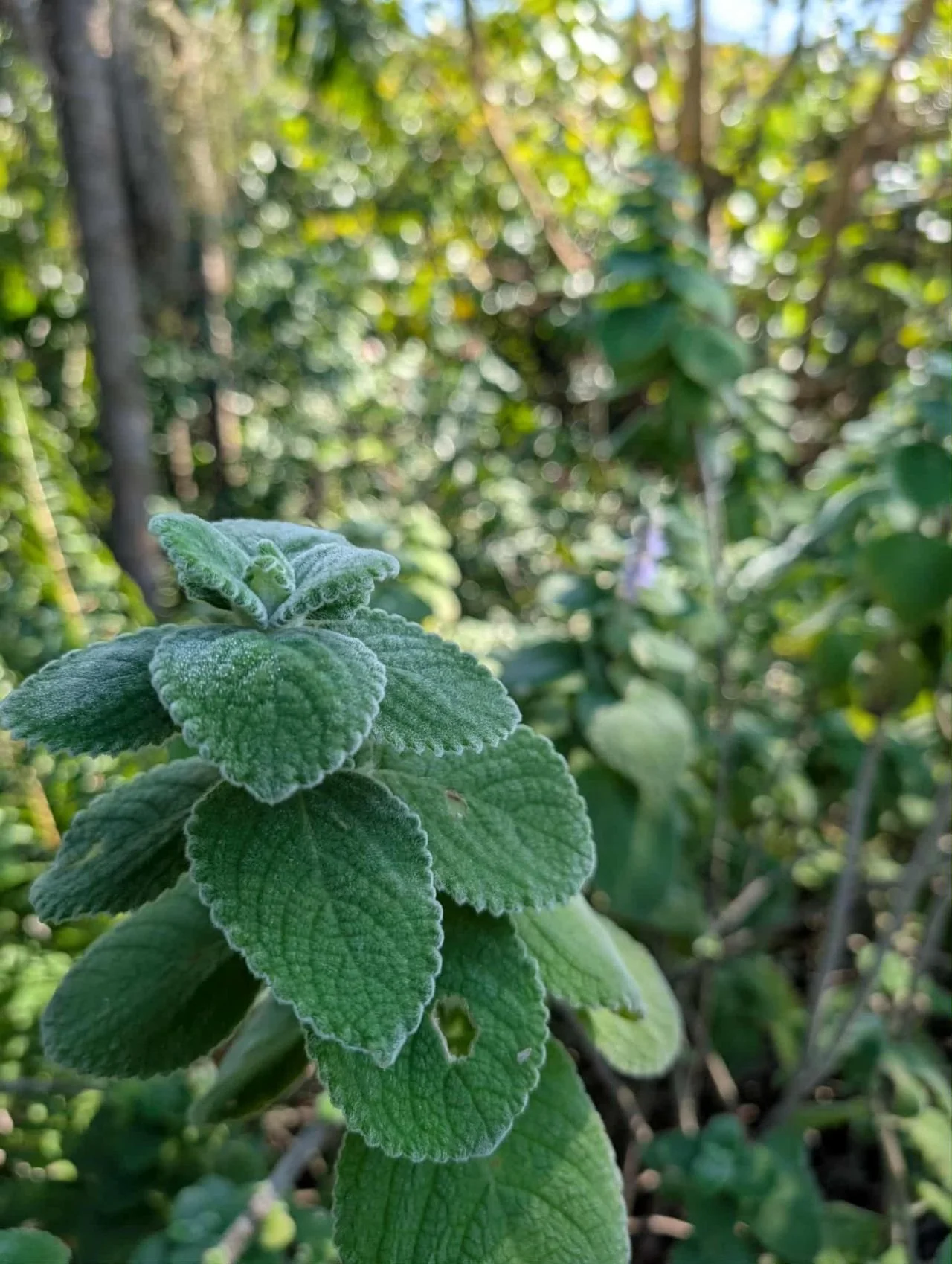
Coleus bellus Rare (Coleus “Mount Carbine”)
Tall, tactile, and bursting with lemon-sherbet scent. Its velvety leaves carry a rich citrus aroma that releases as you brush past. This is a plant for people who understand gardens as spaces to feel as well as look. It makes a fantastic sensory border, cut it back hard, enjoy the soft flushes of new growth, and let it do the work lambs ears can’t do in the tropics and sub-tropics. Or let it standardise for a quivering display of electric green texture in the back of a bed. While not a showy flowerer, C. bellus sports a delightful and reliable sky blue flower.

Coleus alloplectus EN (Slenderleaf Hullwort)
This is my favourite; tough, bronzed, and full of personality. Its new growth bursts in tones of gold, copper and bronze, it sets the stage for bold spikes of purple flowers. It thrives under pressure, responds beautifully to pruning, and pairs exquisitely with native garden design tones: olive, parchment, drab, stone, silver and dun. It’s a complementary gem with year-round interest.
Shiny, Dead, and Overpriced
This blog dives into how we've been sold the idea that "clean" and "premium" means better but when it comes to honey, coconut oil, and fertilisers, the truth is often the opposite. Learn how processing strips products of their life, and why real change starts at the checkout.
Today I found out something that honestly blew my mind.
People still buy honey from the supermarket and have no idea that it’s fake! Somehow, we’ve normalised honey that stays perfectly liquid forever. We’ve been sold the idea that clear liquid honey is better, when in reality, it often just means overly processed, lifeless, and ineffective.
This rabbit hole doesn’t stop with honey. It runs deep through our pantries, our skincare routines, and even our gardens.
Crystallisation is Life
Real, raw honey crystallises. It’s supposed to. That process is natural, a sign of the presence of glucose and trace particles like pollen that trigger crystallisation. Supermarket honey doesn’t crystallise because it’s been aggressively processed to improve its shelf appeal and extend its use-by date.
That usually means:
Heat treatment (pasteurisation) - heating honey to around 60–70°C breaks down crystals and slows crystallisation, but it also destroys the natural enzymes (like diastase, invertase, and glucose oxidase), which are responsible for its antibacterial, antioxidant, and digestive properties.
Ultrafiltration - this removes not only particles like wax and pollen (which are natural indicators of origin and quality), but also strips away much of the honey’s flavour complexity, nutrient density, and trace minerals.
Blending from multiple, often international sources - most commercial honey isn’t single-origin. It’s pooled from various suppliers, sometimes across countries, to create a uniform, supermarket-friendly product. This means you have no real idea where your honey comes from, how it was produced, or what standards it was held to.
What you’re left with is honey that looks “clean” and pours neatly but is void of life. No active enzymes, beneficial microbes and worse no subtle floral signatures from the plants the bees foraged.
It’s essentially just sugar syrup with a great marketing spin.
Real honey, raw and unfiltered, varies in colour and flavour with the flowers of the season, and yes, it crystallises over time. That crystallisation isn’t a flaw. It’s a feature. It tells you that the honey still contains all its natural compounds, just as the bees made it.
Want to go deeper into what real honey is (and isn’t)? Read my full honey blog here
Fractionated Means Stripped Bare
Next stop on the deception train: coconut oil.
You might see “fractionated coconut oil” sold at premium prices. Some companies even market it as better than real coconut oil, thanks to its “feather-light emollient effect” and “Certified Pure Tested Grade™” status.
Sounds fancy, right?
But fractionated coconut oil is just coconut oil that’s been processed to remove the fatty acids that give it any real benefit, especially lauric acid, which is what gives virgin coconut oil its antibacterial, antiviral power.
It’s clear, it doesn’t solidify and it looks “pure” but to get to that point, it lost everything that made it good.
So while it’s stable and neat and won’t harden in the cupboard… it’s also nutritionally meaningless.
Fertiliser Fakery: When “Organic” Isn’t Alive
And then we get to the garden aisle.
Everyone wants organic fertiliser these days. Pelletised, easy to apply, no smell, no mess. Sounds ideal, right? There’s a problem with that, most pelletised organic fertilisers are made using high heat extrusion.
That means they’ve been cooked at temperatures that:
Destroy microbial life
Break down beneficial compounds like humic and fulvic acids
Leave you with pellets that do very little for the soil
So you’re spending money on “organic” fertiliser that’s just dead bulk.
Organic Link I have found is one exception. Instead of heat, they use low-temperature dehydration to form their pellets. This method retains soil-loving microorganisms, active humic substances and actual organic nutrients that actually feed your soil
Destroying Life for Aesthetics
I wish my daughter came up with this catch phrase, but she didn’t. We are living in a culture that promotes clear and beautiful over real and healthier. We’ve been trained to value appearance, convenience, clarity, and neatness over substance, integrity, and function.
Let’s be honest, most products on our shelves have been overly processed, stripped, sterilised, and deactivated, all in the name of shelf life, marketing, “premium” appeal and profit. These products have lost their soul, and I feel so are we by allowing this to happen. Normalising this.
Can we all just take a moment… and think?
Seriously. Use our brains.
Corporations aren’t here to save us. Capilano isn’t here to give us real honey. No one is offering us real food anymore. And let’s be honest, our government is doing nothing to protect the farmers who actually feed us.
So let’s start a movement. Let’s start with honey.
Stop buying the supermarket stuff, I don’t care how fancy the label looks. Buy from a local beekeeper. Ask where it came from. Learn what real honey tastes like. And once you’ve made that switch, let’s talk about eggs. Then meat. Then the rest.
Because change doesn’t come from the top. It starts at the checkout.
“If you think you’re too small to make a difference, you haven’t spent the night with a mosquito.” African proverb
Real consumers ask questions.
So let’s start asking them and let’s start now.

The Native Garden: A Balanced Approach
Amid discussions about exotic species becoming problematic in Australia, it’s crucial to re-examine native plants' role in our gardens. While I cherish native plants, I also appreciate many exotic species and believe they can coexist harmoniously.
Recognise that native plants can become weeds, like the Cootamundra Wattle (Acacia baileyana), which can invade higher rainfall areas. Native gardens require effort, including soil cultivation, fertilising, and regular maintenance.
Genetic modification to meet consumer demands for constant flowering plants risks diluting native species' genetic integrity, weakening resilience and harming ecosystems.
By prioritising robust genetic traits and educating consumers, we can create sustainable gardens that celebrate both native and exotic species.
With the ongoing discussions about some exotic species becoming problematic in parts of Australia, I felt it was time to reveal that while I love native plants, I also have a deep appreciation for many exotic species and believe they can coexist harmoniously.
The Native Plant Misconception
It’s important to recognise that just because a plant is native doesn’t mean it won’t become a weed. Take the Cootamundra Wattle (Acacia baileyana) as an example. This beautiful, fast-growing acacia is naturally restricted to the South Western Slopes of New South Wales. When planted in higher rainfall areas, it can aggressively invade surrounding bushland, self-seed, and become a nuisance.
Another misconception about native plants is that they require little to no maintenance. A native garden, like any other garden, requires effort. This includes:
Soil Cultivation: Regularly improving soil with compost and organic mulch.
Fertilising: Using products like Organic Link at the start of each season and supplementing with regular liquid fertilising.
Maintenance: Trimming and replacing plants as weather conditions change.
Responsibility
People must start to take responsibility for our plants and gardens. For instance, Syngoniums, a popular houseplant, are classified as weeds. Do we stop cultivating this plant, or do we educate and ensure responsible care and correct disposal, if needed? As a professional horticulturalist, I explain the potential pitfalls and dangers of allowing such plants into the wild. I expect their new owners to trim and care for them to prevent them from becoming out of control. I expect people to allow themselves to be educated and take on that advice. You cannot buy a climber and then get upset when it climbs.
Choosing the Right Plants
Reputable Sources: I only purchase plants from reputable sellers. For example, seed-grown vinca (which I do not sell) can be a weed, but with modern horticultural advancements, sterilised vinca won’t usually last longer than 6-12 months (this is what I stock).
Local Availability: Many Southeast Queensland natives are not commercially available because they are hard to cultivate in large numbers or aren’t as visually appealing as their Western Australian counterparts. Thus, a native garden in Ipswich might consist of 20 Western Australian and South Australian natives and only a couple of Southeast Queensland natives.
Genetic Dilution in Local Australian Plants
Genetic dilution refers to the weakening or loss of genetic diversity in local native plant populations due to cross-breeding with introduced species from other areas or non-native species. This can lead to several ecological and evolutionary problems, including reduced adaptability to local conditions and the loss of unique genetic traits.
An example of this happening is with the Australian native Corymbia torelliana, commonly known as Cadaghi. It is native to northern Queensland, Australia, and has been widely planted outside its native range due to its fast growth, aesthetic appeal, and usefulness in timber production.
Corymbia torelliana can hybridise with closely related species, such as other Corymbia species and some Eucalyptus species. When this occurs, the genetic material of Corymbia torelliana mixes with that of the native species, resulting in hybrid offspring. These hybrid offspring may exhibit reduced fitness compared to pure native species, including traits such as lower resistance to local pests and diseases, or reduced adaptability to local soil and climate conditions.
The genetic dilution of native species can also lead to a reduction in biodiversity, potentially disrupting ecosystem functions such as nutrient cycling, water regulation, and habitat and food provision for other species.
Corymbia torelliana produces a large amount of pollen, which can be dispersed over long distances by wind or pollinators like bees. This increases the likelihood of cross-pollination with native species over longer distances. Just one tree can affect a very large area.
The Role of Exotic Plants
Native and European plants can be used together. Many fruit trees and vegetables aren't native, but that doesn't mean we should stop growing them. Many herbs, like garden mint, and comfrey, can become weeds, yet we don’t stop cultivating them. Instead, we focus on education and responsibility.
I have personally found Camellia sasanqua flowers and bacopa (both exotic) are a preferred flower for my native bees. Lemon Balm (Melissa officinalis) was traditionally used by the ancient bee keepers. They used to rub the crushed leaves on the beehives to encourage the domesticated bees to return to their hives. They also believed that the lemon balm would also bring new bees to the hive.
Creating a garden, whether it be native or a combination, requires thoughtful planning and effort, but the results are worth it. By understanding the specific needs of our environment and taking responsibility for our plant choices, we can create beautiful, sustainable gardens that celebrate both native and exotic species. Let’s continue to educate ourselves and others while embracing the diversity that makes our gardens thrive.