Find Us:
77 Fernvale Rd
Brassall QLD 4305
(07) 3201 8630
Open:
Tue-Sun 9am - 4pm

My Flowers bring all the Bees to the Yard
Here are a list of some of my favourite bee attracting plants. When I say bee I mean all bees. Some plants will attract European bees and some will attract native bees. I don’t discriminate, I love them all and want all of them visiting my garden! This list is not exhaustive it’s just a list to get you started.
Question
I would love some suggestions for bee attracting plants that will be happy in clay soil and Ipswich climate. We have plenty in flower at the moment (mostly bottle brush and lillipilli) but would love some suggestions for other times of the year. We do have some citrus which flower periodically too.
Trevallan’s Answer

Clay soils can be a problem for many plants. I do always suggest your cultivate your soil as much as possible with compost, Searles Soil Activator and/or Plant of Health’s Liquid Soil Microbes. Always use an organic mulch like sugarcane or tea tree as the more it breaks down the better the soil becomes. Always use organic fertilises like Organic Link or Pelletised Five In One.
Switch to organic pesticides.
There are some plants that just won’t grow for us in the ground and that’s ok. Use groups of large pots in the garden. I love placing pots around in my garden, it gives the garden another dimension and it allows me to have things I may not be able to grow if it was growing in garden soil. Hanging baskets are another great way to add a new dimension to your garden. You don’t have to hang hanging baskets on your patio .... use large tree branches and hang them in your garden.
Also it’s a great idea to have shallow water dishes around the garden so the bees can rehydrate. Yes, you have to fill them regularly in the heat but the little things we do for wildlife goes a long way and they will repay you by pollinating your vegetables and fruit!
Some of the mentioned plants are seasonal and some are forever. Some will grow better in part sun and some can handle all day sun. Some are trees, some are small. All will grow in Ipswich.
So here are a list of some of my favourite bee attracting plants. When I say bee I mean all bees. Some plants will attract European bees and some will attract native bees. I don’t discriminate, I love them all and want all of them visiting my garden! This list is not exhaustive it’s just a list to get you started.
Bacopa
Camellia Sasanqua
Grevilleas
Lavenders
Fruit trees
Salvia
Daisies
Buddleja
roses
Penstemon
sunflower
marigold
Dandelion
Calendula
Pentas
African Blue Basil
Most herbs left to flower
Alyssum
Murraya paniculata
Jasmine
Aster
cosmos
Lemon Balm (Melissa officinalis)
Borage
Native hibiscus (Alyogyne huegelii)
Guava
Macadamia
Backhousia citriodora
Eucalyptus
Strawberries
Blueberries
Any Syzygium but my favourite is Cascade
Leptospermum
Callistemon
Westringia fruticosa
Waterhousea floribunda
Buckinghamia celsissima
And this list can go on and on.
I also have Eden Seeds bee flower seed mix, which is mixture of flowering plants. Cultivate soil, throw out seeds and see what comes up.
HAVE FUN
“If the bee disappeared off the surface of the globe, then man would have only four years of life left. No more bees, no more pollination, no more plants, no more animals, no more man.” Albert Einstein

Macadamia tetraphylla
Macadamia tetraphylla is native to southern Queensland and northern New South Wales and is now classed as a vulnerable in the wild. Macadamia tetraphylla has a higher sugar content than Macadamia integrifolia. Having a higher sugar content makes it really yummy when eaten raw but can lead to burning when used in baking.
Did you know that Macadamia tetraphylla was the first Australian native food plant to be grown by non-indigenous Australians as a commercial crop?
What’s even cooler is that seedlings from this original plantation were used as rootstock for grafted modern varieties of Macadamia Nuts well into the 20th century.

Macadamia tetraphylla from Royal Botanical Garden in Sydney
In recent times commercial growers have stopped growing Macadamia tetraphylla and preferred to grow Macadamia integrifolia (Macadamia Nut most of us know and love). The reason for this is the Macadamia tetraphylla has a higher sugar content than Macadamia integrifolia. Having a higher sugar content makes it really yummy when eaten raw but can lead to burning when used in baking.
Macadamia tetraphylla is native to southern Queensland and northern New South Wales and is now classed as a vulnerable in the wild.
Macadamia tetraphylla has long, pendulous nectar rich pink flowers that the insects and birds adore. They also have a delicious scent. After the flowers woody, rounded fruits appear which contain the edible seeds.
It can grow to 18m in best conditions but can be kept smaller. It is best suited for people who have space and is an excellent shade tree.
These trees are best growing in the ground. Best planting advice is dig your hole twice as big as your pot. Back fill with excellent quality garden soil and plant your tree, fertilise with Organic Link when planting. I like to fertilise all my natives on turn of every season (every three months) with Organic Link. It usually takes around three months for a tree to fully establish itself. Keep water and liquid fertiliser up to your tree over this time and allow it to get the best possible start in life.
We have some of these beauties in stock now

All about Bees
Bees pollinate over a third of the food we eat. Unfortunately, bee populations all over the world are declining which in turn is affecting the availability of our food.
Bees.
Just the word alone, can strike fear into some people. But did you know they are an essential element in the circle of life?
"If the bee disappeared off the surface of the globe, then man would only have four years of life left. No more bees, no more pollination, no more plants, no more animals, no more man." Albert Einstein
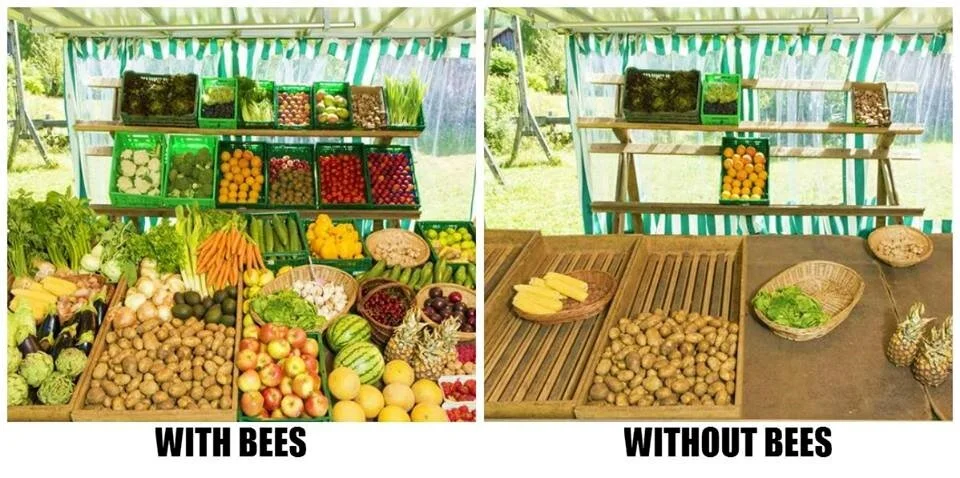
Bees pollinate over a third of the food we eat. Pollination is the process by which pollen is transferred in the reproduction of plants, thereby enabling fertilisation and reproduction, or in layman’s terms, bees help the flowers turn into food.
Unfortunately, bee populations all over the world are declining, which in turn is affecting the availability of our food.
The three main causes are believed to be Genetically Modified Crops (GMOS), chemical pesticide use and habitat loss.
Without getting into a huge debate on GM crops, it is believed one of the main reasons GM crops are leading to colony collapse is that the flower pollen on GM crops is sterile, thus causing the bees to become undernourished and die.
Bees generally travel as far as they need to get food. It is believed that the highest rate of return is between 6 to 7kms away from their hive. Therefore, if a hive is surrounded by GM crops the hive will die out.
The same goes for pesticides. If pesticides are being sprayed in an area, there is a high possibility that the bees will become infected and die out. Home gardeners should note that toxic pesticides meant to kill the bad bugs in our gardens can actually harm the bees which are so important to our environment and survival. Fortunately, Australia has banned many of these harmful pesticides in home use and luckily for us gardeners, there are alternatives. These alternatives are completely organic and don’t harm bees or any other good bugs, but do harm the bad bugs.
The third reason for decline is loss of habitat. This is brought about by development, abandoned farms, growing crops without leaving habitat for wildlife and growing gardens without flowers, or flowers that are not friendly to pollinators.

The larger honey bee (left) shown with the smaller stingless bee (right) on Citrus. Credit: (c) Tobias Smith
In Australia, we have some amazing native bees. There are over 1700 native bees and about ten species of small black stingless bees. They are only about 4 mm long, compared to 12 to 16mm long of the honey bee. The best thing about Australian native bees is that nearly everyone can have a hive or two in their yard.
Many years ago, I visited Melbourne and it seemed most of the suburban garden centres had a native bee hive in their centre. It was fantastic.
Why do we want a native bee hive in our yard?
Australian stingless native bees can be excellent pollinators of certain crops in Australia. They are particularly useful for macadamias, mangoes and watermelons. Also, they are not as prone to the colony collapse disorder that has decimated honeybee populations.
If we can increase the amount of Australian stingless native bees, we might be able to help reduce the loss of food production. Additionally, we might be able to assist the pollination chances in our fruit and vegetable patches.
Australian stingless native bees only produce small amounts of honey - less than one litre per year, particularly in warmer parts of Australia. However, it’s worth the effort as this honey (known as Sugarbag) is delicious.
Anyone can get a Native Bee Hive, as they don’t need as much attention as commercial honey bee hives and akin to the commercial honey bees, have an interesting social behaviour. Contrary to popular belief, you don't have to only have native flowers- I've seen Australian stingless native bees in a buzzing in a frenzy over camellia blooms. Furthermore, it’s worth knowing that increasing the number of Australian stingless native bees will NOT lead to a reduction in Honey bee population. The two can work in harmony.
If you’d like a hive go to the Australian Native Bee Association or Aussie Bee and see if there is a reseller near you. The ANBA promotes the conservation and sustainable use of all Australian native bees.
Do I have bees?
Take a walk around your garden early in the morning. Do you see any bees, native or European? What are they feeding on? I bet it’s not your beetroot leaves or agave leaves!
Growing your own vegetables is a brilliant idea, but don’t forget to mix it up and include some flowers in your edible garden! If you are completely against flowering plants, get some fruit trees, or let some of your vegetables go to flower or plant vegetables that flower, like pumpkin.
We all need to do our bit to keep the bees happy!