Find Us:
77 Fernvale Rd
Brassall QLD 4305
(07) 3201 8630
Open:
Tue-Sun 9am - 4pm

Camellia Japonica
Do yourself and your garden a favour and treat yourself to a Camellia Japonica. These glorious plants are sometimes called the Rose of Winter.
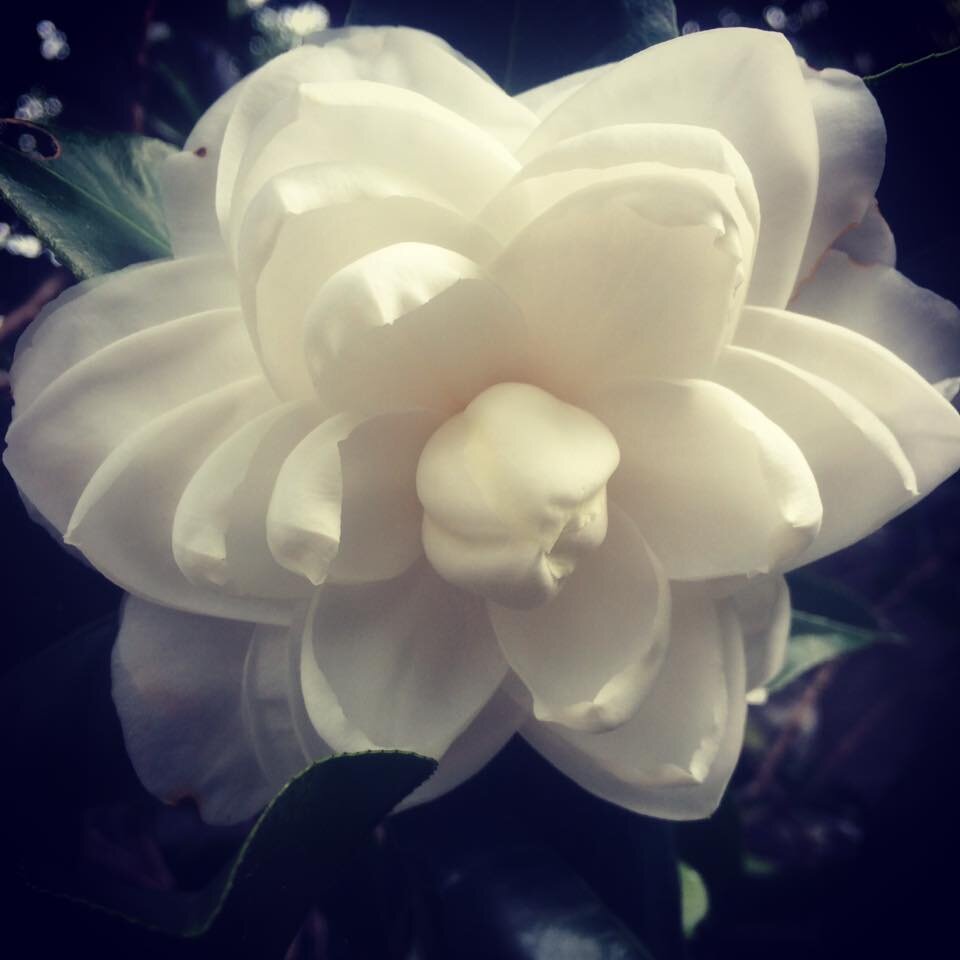
Over the years my grandfather has tried to teach me a lot. He tried to teach me to fish but I could never stand still long enough to catch anything! He tried to teach me to cylinder mow but I could never get the hang of mowing in a straight line. He even tried to teach me to be a little quieter and we all know that didn’t work! The one thing he did teach me well though was how perfect Camellia Japonicas are.
Do yourself and your garden a favour and treat yourself to a Camellia Japonica.
These glorious plants are sometimes called the Rose of Winter. I think they should be called the Jewel of Winter because they put on a fabulous flower display in the cooler months of the year when the rest of the garden often looks dull and bare.
Japonica flowers are what make this plant so perfect.
I get such joy in seeing the buds open to these so flawless and diverse flowers. I have found over ten different descriptions of Japonica flowers. The most common are single, double, peony and formal double. The shade of the flowers are just as diverse and can vary from red to pink to white and sometimes have multi-coloured stripes or specks. The flowers are not small either with many flowers being at least 15cm in diameter. What is even better is these plants flower in abundance and the flowers last for ages. A childhood memory is of water bowls all over our house filled with japonica flowers.
Camellia Japonicas have the darkest green glossiest foliage. The leaves are quite broad, thick and smooth making the plant look lush and dense. Japonicas will grow superbly in full shade or part shade. In climates where deciduous trees are popular japonicas are usually planted underneath so they are protected from the hot summer sun but are free to shine while they are in flower and the tree is naked.
Japonicas don’t mind if they are planted in the ground or in a pot. They don’t like wet feet though so make sure your soil is well drained and slightly acidic, around pH6. They are quite hardy once established. I find they do best if they are mulched well and are given a good fertilise about every three months with a slow release complete organic fertiliser like Organic Link. I also like to give my japonicas a granular dose of sulphate of potash around April/May to help promote flowers. During their flowering season I liquid Plant Care them on a regular basis to keep them healthy while in bloom.
About once a year usually around the end of August I add a little bit of Dolomite to the soil around my camellias. Camellias can be prone to calcium deficiency and I find adding a little bit of Dolomite helps with this. If I can’t add Dolomite (or I forget) I try to Liquid Bio Trace my Camellias at least twice a year.
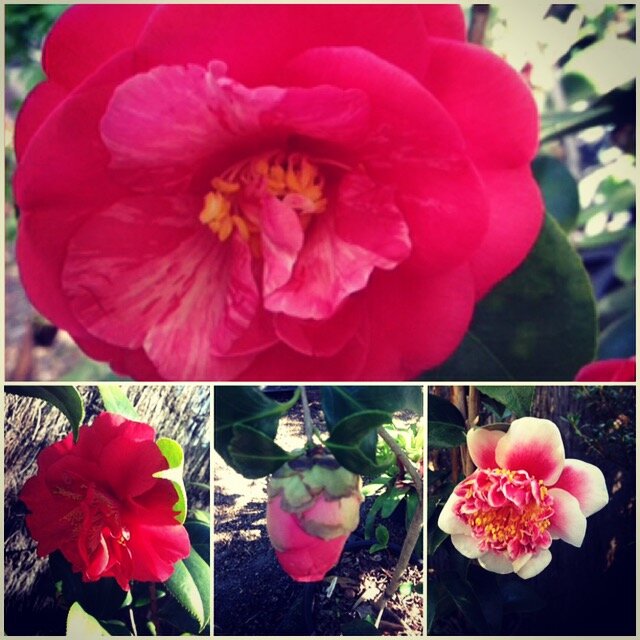
Camellia Japonica Flowers
Why doesn’t everyone have one of these glorious plants?
Over the years they have gotten a bad reputation because they are slow growing and some varieties can take years to flower or suffered Bud Drop.
Beautiful plants do not grow overnight and it is nice to have a plant that does not need constant trimming.
Bud Drop is the loss or decay of buds. This can be caused by over watering (we sometimes get wet winters), high temperatures (we sometimes have hotter than expected winters), pot bound roots and incorrect positioning.
Some Japonicas can take years to flower and some don't flower that well in our climate. I remember my mother waiting years for our 'Waterlilly' japonica to flower. It was well worth it but seriously!!! I have found in Ipswich's unpredictable winter climate the formal doubles struggle to flower spectacularly every year, the others flower very easily.
There are many japonicas that are perfectly suited to flower and grow in Ipswich. Don't ever forget that even one Camellia japonica in a pot on a veranda is the perfect way to give your dull winter life some TLC and bring some happiness back into your garden!

Bloomin' Fabulous
Potassium Sulphate or Sulphate of Potash is commonly called Potash. It is an essential element necessary to the lives of all plants.
A common question I am asked is "why didn't my fruit trees fruit profusely or if they did why was the fruit misshapen?" Or "why didn't my camellias and azaleas flower as well this year?" Or even "why are all my coloured foliaged plants like crotons and dracaenas losing their colour?"
The answer is usually quite simple - Your garden just needs some TLC and maybe a little Potash!
Potassium Sulphate or Sulphate of Potash is commonly called Potash. It is an essential element necessary to the lives of all plants.
It aids in disease resistance and frost protection by strengthening the plants cell walls. It helps in seed and root development. It encourages strong new growth and helps with the formation of flower buds and fruit.
Potash can improve the quality and the colour of flowers and enhances the formation of proteins and sugars in fruit. Potash can even help plants with slender stems and large flower heads such as Iceland poppies and gerberas hold their heads erect.
Potash defective cues can be seen in a number of ways in your plant. Your plants might be showing signs of overall weakness especially in its stem. It could have yellowing leaf margins and grow more slowly. It could also be disease prone and its fruit and flowers will be small and poorly coloured and sometimes tasteless.
Don't confuse a potash deficiency though with an unhealthy plant. Always make sure you have given your plant some complete slow release organic fertiliser like Organic Link and a Bio Trace first.
Complete fertilisers, whether they are chemical or organic, usually contain potash. Organic Link contains potash. An N:P:K ratio can usually be found on the fertiliser label. A very quick explanation of the N:P:K ratio is - N stands for Nitrogen (greening, growing), P Phosphorus (roots) and K Potassium (fruiting, flowering).
If you use mainly a manure based fertiliser like blood and bone or chicken manure you will need to add potash as these products don’t naturally contain it.
Potash also is available by itself in a liquid form and a granular form.
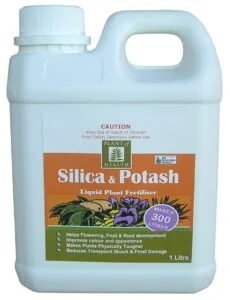
The liquid form is added to water and used as a foliar spray. Used like this it is quick acting but not long lasting and needs to be repeated on a fortnightly basis. This is best for promoting flowers especially on annuals. I use Plant of Health's Potash and Silica.
The granular form is added to the soil and watered in. The granular is slower acting but lasts a lot longer. This is best for correcting deficiencies, promoting fruit and stimulating coloured foliage. We use Searles' Potash.
This weekend I want you all to get some granular potash and go a little silly in your gardens.