Find Us:
77 Fernvale Rd
Brassall QLD 4305
(07) 3201 8630
Open:
Tue-Sun 9am - 4pm
Spathiphyllum
Perfect Indoor Plant, this plant is an understory plant of the rainforest and basically requires very little light (hence its common name 'Dungeon Plant') and very low water. Which is probably why it was so popular.
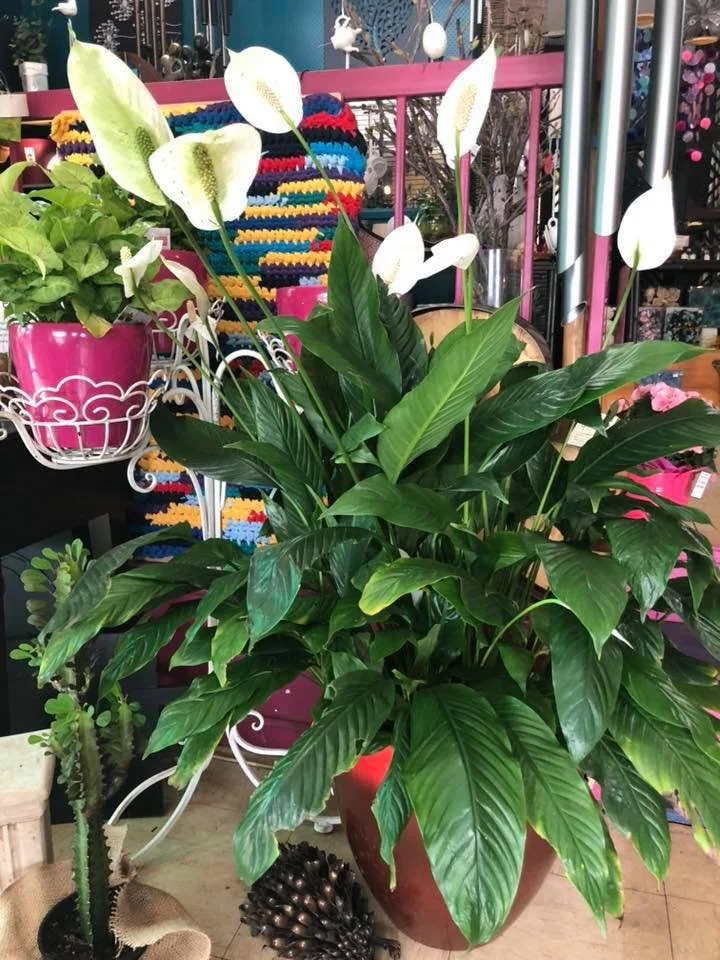
Spathiphyllum, spath, Peace Lilly, dungeon plant!
It's the original 70s house plant. In recent times it has become popular with the emergence of the variegated foliage forms.
Why is this plant so popular?
Lush green foliage, flowers consistently through warmer months, easy to take care of, works inside or shade gardens!
There are so many forms of Spathiphyllums, you can’t get bored!. Short and fat lush green leaves, long and skinny lush green leaves, big and fat lush green leaves and Giganotosaurus lush green leaves. There is also a form that has crinkly green and white variegated leaves and just a flat glossy variegated leaf. There is also a silver leafed form.
All have beautiful white flowers. Some flowers sit high out of the foliage and some sit in amongst the foliage. Some are big and some are little.
This plant is an understory plant of the rainforest and basically requires very little light (hence its common name 'Dungeon Plant') and very low water. Which is probably why it was so popular.
The NASA Clean Air Study has also found that Spathiphyllum cleans indoor air of certain environmental contaminants, including benzene and formaldehyde.
Seriously how could one not want this indoors....
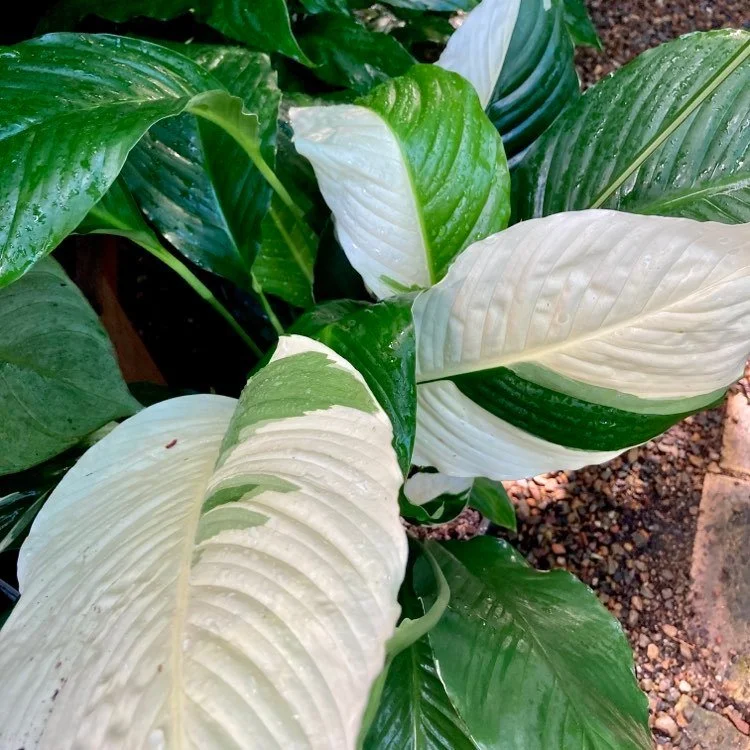
Spathiphyllum Picasso
Oh well here we go .....
We worked out the flower wasn't good for our kids or animals to eat, so it slowly got banned from the homes of plant eating animal and children.
Then the tips of the leaves started turning brown and yellow making the plant look ugly and not Insta worthy.
Now that's because we all became afraid to give our plants a good drink. Spathiphyllums don't like it when you consistently give them little bits of water (shallow watering). I know you don't want to ruin Aunt Frans antique table with water running every where, so invest in a planter or take your Spathiphyllum to the sink to water it.
Spathiphyllums like a good long drink where water flows through the soil and out the bottom. Once a week is usually fine. If it doesn't last that long you need to reassess what your Spathiphyllum is planted in.
Spathiphyllums should be planted in a fantastic quality potting mix, remember they are understory plants living and surviving in decaying matter! The better the quality of potting soil, the less watering you'll need to do. I always use Platinum potting mix.
If you don’t want to repot your Spathiphyllum try using Searles Recharge. Recharge does what it says recharges old potting mix. I love this product and use it about once a year on all my indoor plants.
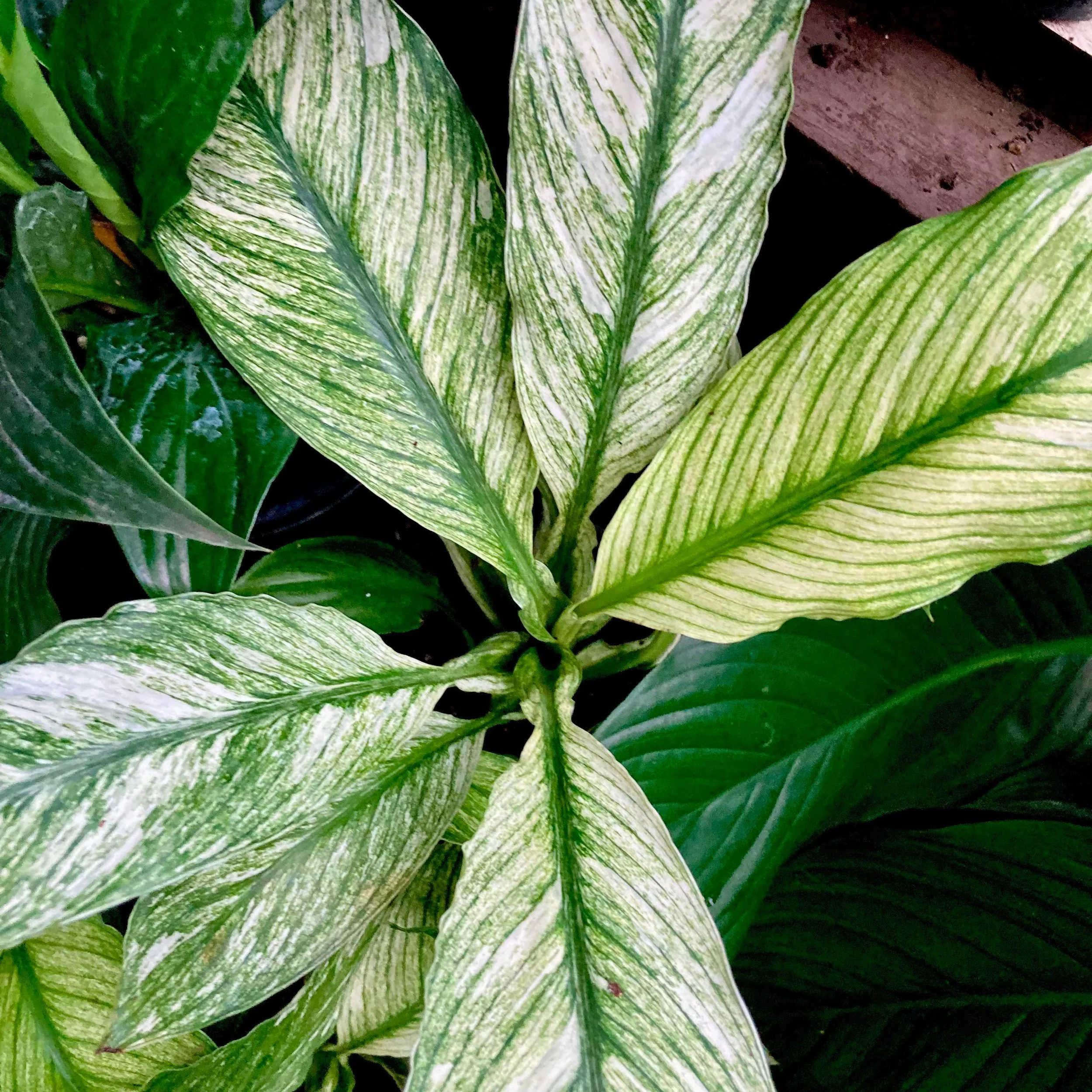
Spathiphyllum Sensation variegated
Spathiphyllums also don't like sitting in wet muddy yucky potting mix either. So make sure your soil is free draining.
Now the most annoying reason Spathiphyllums got a bad rap is the flowers turning green ... why they do that?
Well it is believed it's due to two major issues. From my research they are unsure which is main reason. I have started a few experiments at Trevallan.
Firstly Spathiphyllums prefer low light (remember understory plant) too much light makes the chemicals in the plants brain go all funny and it produces the green flower.
Secondly Spathiphyllums like certain nutrients. Green flowers can be caused by a chemical imbalance caused by under or over fertilisation. Too much or too little of what they are still unsure. When you do get green flowers why not try Bio Trace, a complete trace element liquid feed, to help the plant adjust and hopefully start producing white flowers again.
At the end of August I always give my Spathiphyllums a handful of granular sulphate of potash. I have found the use of potash at this time of year gives me great white flowers at Christmas.
I truly love this easy to care for plant

Aglaonema
Aglaonema, what’s not to love? Spectacular Foliage Colours, Fabulous Indoors Plant, Grows well outside in Full Shade but can tolerate a little sun, Great for Pots or Gardens, Tolerates Dry Conditions
Aglaonema, pronounced Agg-low-neem-uh, is another one of my all time favourite house plants.
I think I'm a foliage girl more than a flowery girl.
What’s not to love?
Spectacular Foliage Colours
Fabulous Indoors Plant
Grows well outside in Full Shade but can tolerate a little sun
Great for Pots or Gardens
Tolerates Dry Conditions
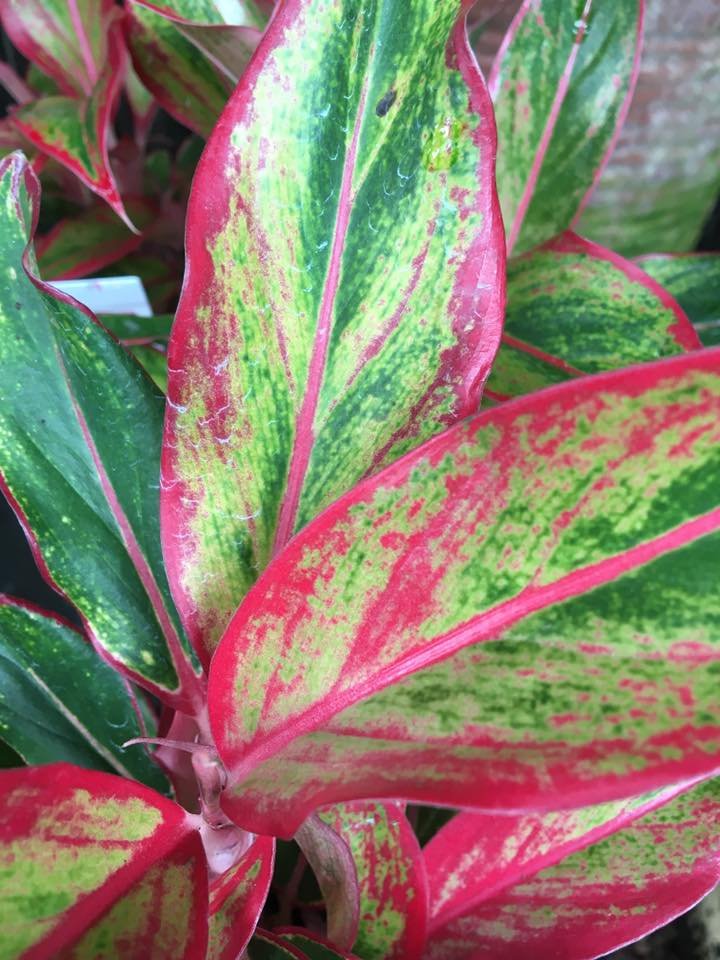
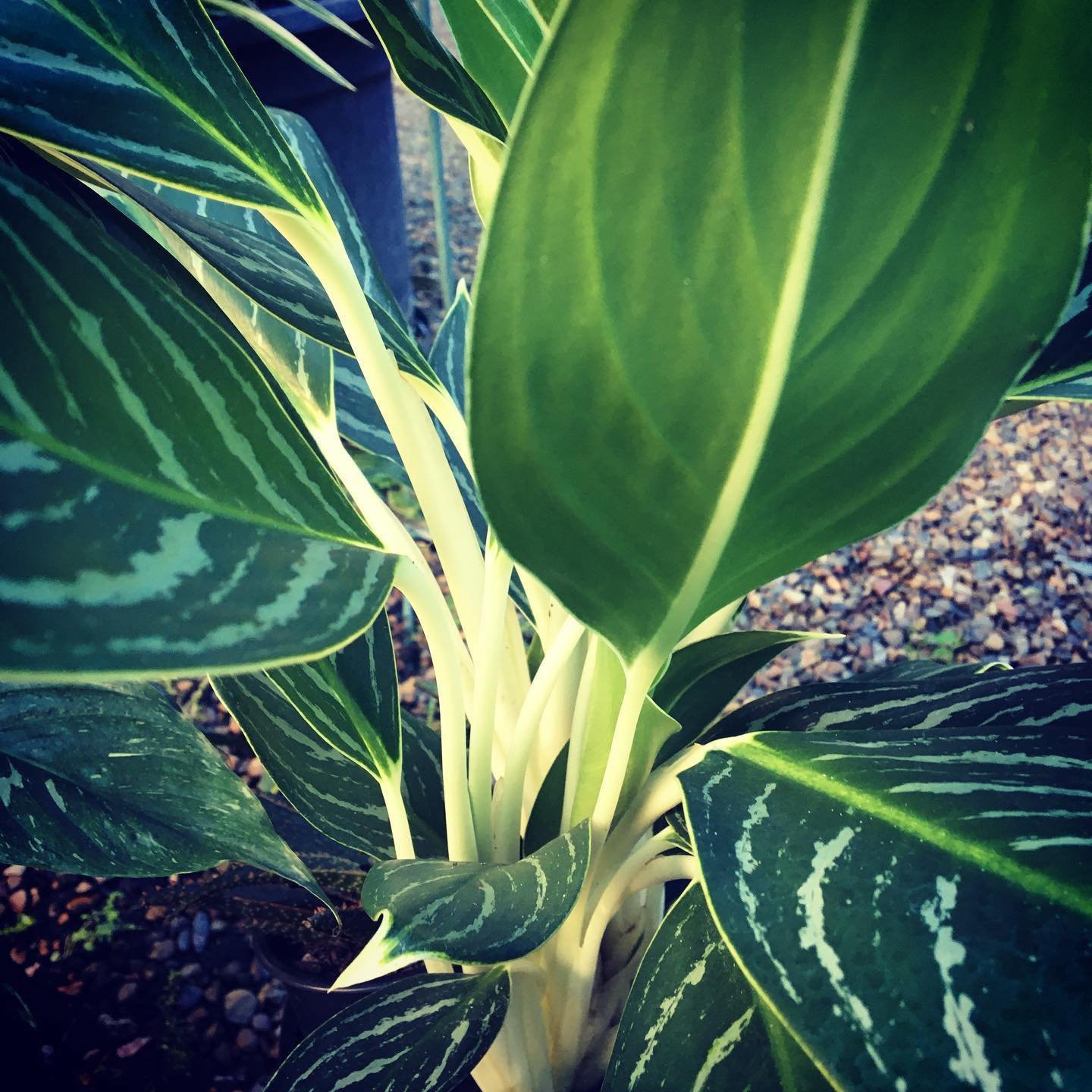
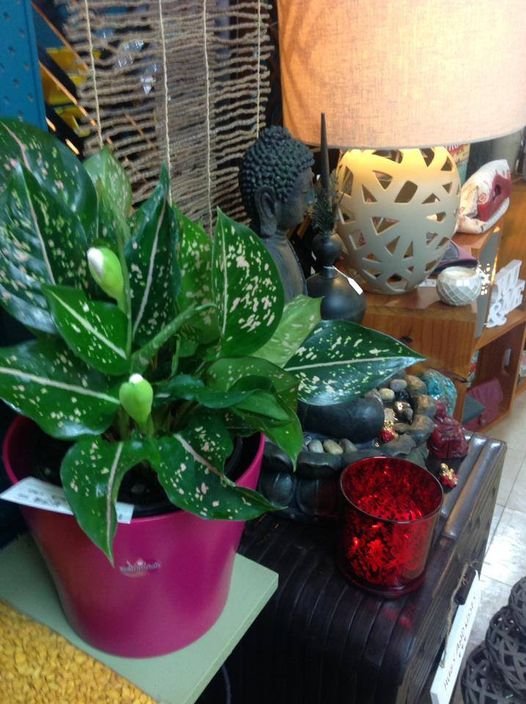
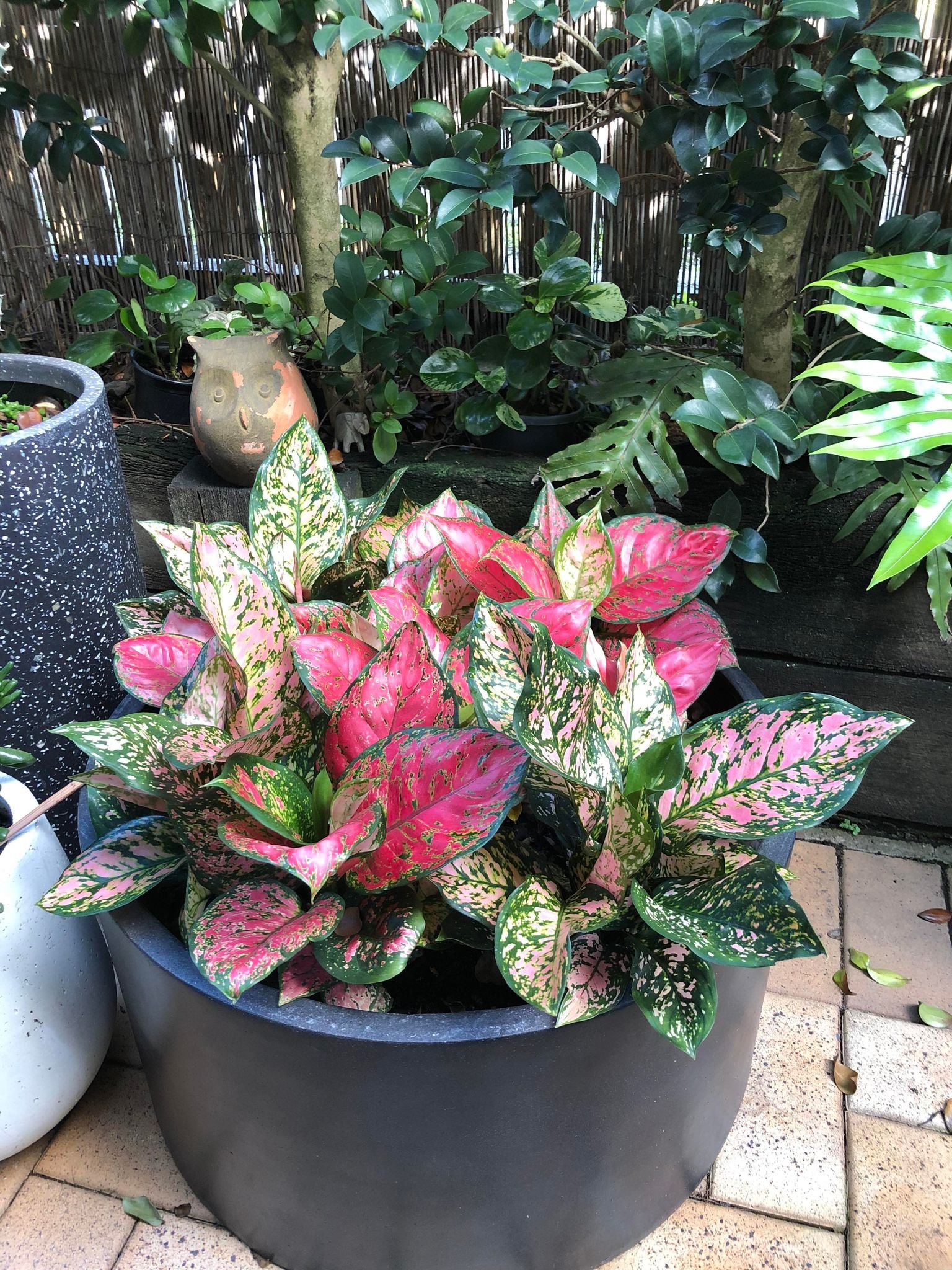
Aglaonemas have attractive glossy variegated foliage and colourful stems. They can be green and white, shades of pink, pink and green, pink and white and all shades in between. There are so many variations it’s easy to start a collection.
I grow them just for the foliage but they do flower it’s just not anything to write home about.
I feel they bring a lovely tropical feel to your indoor space.
Aglaonemas are relatively slow growing. They don't like having wet feet or being overpotted. I find it's better to treat them mean to keep them looking good. I have killed a few over the years simply by never letting them dry out. I now still use an excellent quality potting mix, like Searles Platinum Mix but I just don't water as often and I never let them sit in a saucer of water.
I find Aglaonemas can handle a dark position inside but really thrive in a well lit position. They also don’t mind being planted in gardens or pots outside in shady positions.
I find Aglaonemas to be so versatile, I love using them around the home. Up high, down low, they seem to suit all positions. As an added bonus these plants are known as luck-bringers and The NASA Clean Air Study determined that they were effective at removing common household air toxins formaldehyde and benzene.
So they really are the perfect houseplant. To keep them continually looking good and putting on a great display, fertilise with Plant of Health Eco Friendly Fertilisers Organic Link about every three months and a fertilise of granular sulphate of potash, usually once weather has warmed up, around late August to help to help the foliage remain vibrant. I also like to keep their leaves free from dust so every few weeks I take them outside and give it a liquid feed (and shower) with Triple Boost Liquid Fertiliser.
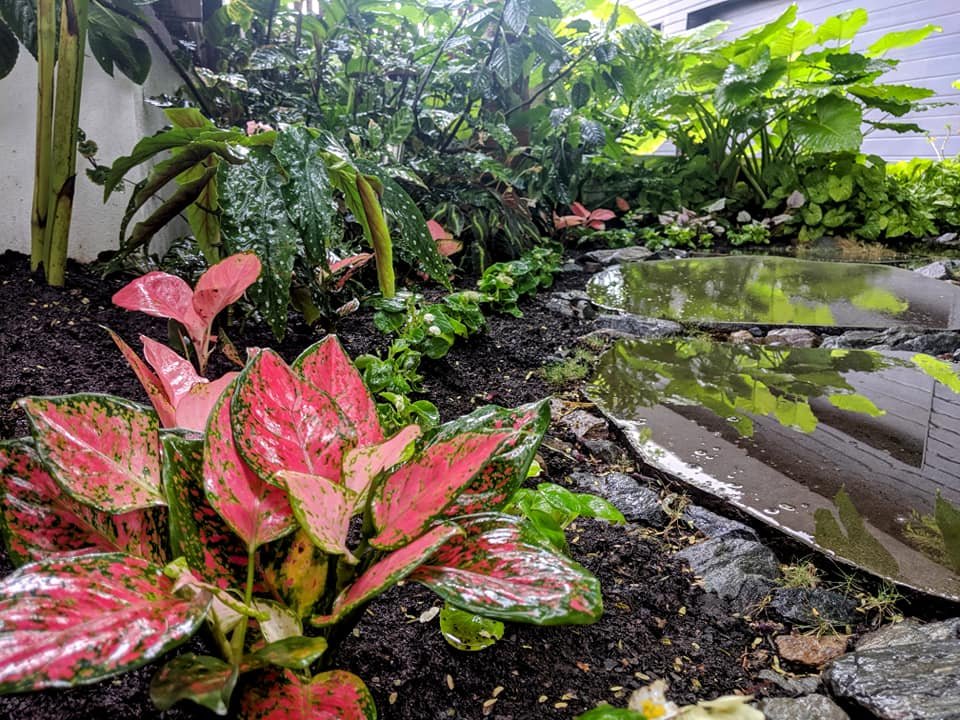
On a side note Aglaonemas are not for human or animal consumption. These plants, like many others, are considered poisonous as they contain calcium oxalate crystals. If ingested they cause irritation of the mucous membranes, and the juice can cause skin irritation and painful rash. So as with all plants unless you know its edible ... Don't eat it!

Dieffenbachia
The best thing about Dieffenbachias is that they look good on a table looking down onto their foliage but they also look great up high looking up into their foliage. They are so versatile and I love using them around the home.
Dieffenbachia, pronounced dee·fuhn·ba·kee·uh, is another one of my all time favourite house plants.
I think I'm a foliage girl more than a flowery girl.

Dieffenbachias can have attractive variegated white and green, cream and green, or all-green leaves that can be speckled, splotched, or loosely striped. There are so many variations it’s easy to start a collection.
I grow them just for the foliage but they do flower and it looks similar to a a peace lily flower.
I feel they bring a lovely tropical feel to your indoor space.
They don't like having wet feet or being overpotted. I find it's better to treat them mean to keep them looking good. I have killed a few over the years simply by never letting them dry out. I now still use an excellent quality potting mix, like Searles Platinum Mix but I just don't water as often and I never let them sit in a saucer of water.
I find Dieffenbachias don't mind a slighter darker spot in the home but the more light they get the shower the variegation in the leaves becomes. The darker the spot the slower the growth and less vibrant foliage colour.
Dieffenbachias can have long and skinny leaves or short and fat leaves. I find if the leaves are long and skinny the plant tends to grow more upright. The fatter the leaves the shorter and squatter the plant.
The best thing about Dieffenbachias is that they look good on a table looking down onto their foliage but they also look great up high looking up into their foliage. They are so versatile and I love using them around the home.
I can group them with other variegated plants like Aglaonemas, with other Dieffenbachias, with lush green plants like Philodendrons or just on their own.
I just love using them around the home. They are one of my first choices with house plants.
To keep them continually looking good and putting on a great display, fertilise with Plant of Health Eco Friendly Fertilisers Organic Link about every three months and a fertilise of granular sulphate of potash, usually once weather has warmed up, around late August to help to help the foliage remain vibrant. I also like to keep their leaves free from dust so every few weeks I take them outside and give it a liquid feed (and shower) with Triple Boost Liquid Fertiliser.
On a side note Dieffenbachias common name is “dumbcane,”! The sap of the plant can cause numbness when touched and interfere with the ability to speak if it gets near your mouth, causing you to temporarily become mute, or “dumb.” So as with all plants unless you know its edible ... Don't eat it!

Calatheas
I was recently asked what’s the secret to growing Calathea, temperamental beauties! Growing Calatheas inside has been a lot of trial and error for me and I have found some do really well and others not so good.
First and foremost you need to remember these plants are native to Tropical Americas. So if your house isn’t a hot humid beach in the Caribbean you are always going to have some issues
I was recently asked what’s the secret to growing Calathea, otherwise known as temperamental beauties!
There is no hard and fast secret with these plants. They kind of remind me of my kids ... they will have a full blown tantrum because the sun came into their room the wrong way one morning, but not be bothered by it at all the next.

Calatheas are pretty much the same- you think you can be doing everything right one day and then boom, the next thing you know it decides everything you’ve been doing is wrong and that’s it. Calathea heaven here we come.
Growing Calatheas inside has been a lot of trial and error for me and I have found some do better than others. First and foremost you need to remember these plants are native to Tropical Americas, so if your house isn’t like a hot humid beach in the Caribbean, you are always going to have some issues.
Calatheas love warm humidity and lots of natural light, but not full sun, so inside you will need to place it in a really well lit area, that’s warm (some houses are cold, think the middle of summer temperatures and air conditioning), and if the air is dry, you’ll need to create some humidity.
I have one room in my house where the morning light streams in and this is where my Calatheas calls home. I make sure they never sit in water - I water them when they are dry, but not too dry, more like ‘I dried out yesterday give me a drink today’ kind of dry.
I have also found with some of them that if I put a little bit of sphagnum moss around the top of the pot and keep it moist, this helps increase the humidity. I spray the foliage about once a week to make sure the leaves don’t dry out and my spray bottle also has a weak solution of Triple Boost. This enables me to feed my plants at same time as keeping up the humidity .
I find that if the tips of the leaves turn a little brown, that’s him screaming at me saying “I’m from the tropics and I demand humidity’.
They really hate the cold, so they may go dormant or even die down in winter if your house becomes too dark and cold. Don’t panic, remember we don’t live in the tropics, so plants adapt. Just remember to not overwater during colder months and try to find the warmest spot you have in the house.
I don’t over pot my Calatheas either, meaning I only ever pot them up to next size pot when they are bursting at the seams of first pot and I only use the best quality potting mix when I do it.

If they do start to look a little worse for wear, they guys can be cut back to ground level just before it gets warm, then simply fertilise and they should shoot back really quickly.I fertilise mine with slow release organic fertiliser, Organic Link, about once every three months.
I really love these plants and while their list of needs seem long and maybe too difficult for some of you, it’s just a matter of finding the perfect spot. The trick with any indoor plant, is find its country of origin and how it grows there, then try to recreate that at home.
I have found these plants work really well indoors in a planter, like a kokedama and in my closed and open terrariums. They can be very versatile and easy to grow, if you are willing in the beginning to put in the effort.

How do I care for my Indoor Plants
There is so much information available and a lot of it is conflicting ... so what’s the real answer.
I find the best way to treat my indoor plants is how I treat gardening in general ... simplicity is key.
I adore my plants but I’m a simple girl at heart.
Although we all love indoor plants immensely, how do we take care of them?
There is so much information available and a lot of it is conflicting ... so what’s the real answer.

I find the best way to treat my indoor plants is how I treat gardening in general ... simplicity is key.
I adore my plants, but I’m a simple girl at heart.
There is always going to be that indoor plant person that makes their own potting mixes and mixes their homemade fertilisers, has humidifiers and growing lamps… and then there is me!
Let’s look at how I treat my indoor plants as the starting point and then you can always work up to grow lamps!
My house is exceptionally dark, apart from one window area. I have learnt that the plant I want isn’t always going to be the plant that thrives.
I’d rather have a house full of thriving plants, instead of the newest release that’s barely surviving. Therefore, I’ve learnt that if I want a certain plant I need a twin. For example, I really love Calatheas, but my house is too dark for them to thrive, so I have two and swap them out fortnightly. This way, I get what I want inside and the plant continues to thrive.
My watering skills are haphazard and I know some plants that can handle this, so I tend to choose these plants over ones that I need to watch the watering. As my house is usually cool and dark, I find watering once a fortnight to once a month is enough for most plants -you just need to find your groove.
I have also learnt that Planters (cover pots) are the best thing for my indoor plants. Planters are pots without holes that literally cover the black plastic pot that your plant comes in. I place my plant inside these (I never usually pot into a planter, there is always an exception) I find planters enable me to swap plants around easily, protect my furniture, as I can give things a good drink without water going everywhere and I can also easily tip out water if the plant gets too much.

Occasionally, I may pot into a planter. If I do, I treat the planter and my potting method the same as I would a terrarium. I use a lot of Sphagnum moss and very little soil, and carefully select what kind of plant I will use.
I treat my plants to a spa day about once every two months. I take all my plants outside to a shady area, I give them some Organic Link slow release fertiliser, wash their foliage and give them a Liquid fertilise with Triple Boost and Neem oil. I usually leave them outside for the evening and bring them back in the next day. The fertiliser I use is same I use in my garden and all my other pots. Remember I keep things simple.
If a plant looks sick, it usually is. Imagine being cooped up inside all day. The best way to tackle a sick plant is to treat it as soon as possible - take it outside to a shady spot for a week or so. Give it a fertilise and a good drink and leave it be. I find most indoor plant deaths come from over love! Also weigh up how much you spent on it vs how much you will need to spend on it to bring it back to vigorous health. Sometimes it is worthwhile to accept a loss and get a new healthy plant, instead of spending months agonising over it.
If I find a plant is always suffering from insect attack inside, I know it’s not meant to be inside. Instead of constantly battling an insect problem, the plant gets treated with neem oil, trimmed and placed in a shady spot outside to live, where I know it’ll be happy.
What works for others may not work for me. This has been the hardest thing to learn. Just because someone is growing a particular plant well, does not mean I will be successful, therefore, I need to make my own rules in my own house.
The best thing I have learned is to not overthink it. Try a new plant, see if you like it, or more importantly, if it likes you. Move it around, buy a pot that suits that particular corner and more often than not, the plant will follow. Just remember to have fun.
Although I don’t always have all the answers, I am happy to help you on your indoor plant journey so pop down to Trevallan today.

Dracaena trifasciata
Dracaena trifasciata is one of my most recommended indoor plants.
It seems to survive the most unsuitable growing conditions, abuse and neglect. Basically, you have to work really hard to kill these Dracaenas. (I must be honest here and mention I have killed one, but it was purely from too much accidental love!)
Dracaena trifasciata, previously known as Sansevieria trifasciata.
Many of us know this plant as "mother-in-law's tongue" or "snake plant", supposedly because of the shape and sharp margins of its leaves.
One gardener told me it's called mother in law’s tongue because it's so hard to kill!
Another common name for this plant unbeknownst to me is the "viper's bowstring hemp", because it is one of the sources for plant fibres used to make bowstrings.
Dracaena trifasciata has had a hard life. It’s native to tropical West Africa and when it came to Australia, it was used outside in garden landscaping as it was so tough and hardy. Unfortunately, it got out of hand, people started to dump it in bushland and it found itself on the weed list.
However, I believe though that this plant can be used effectively and non-invasively when used as an indoor plant.
Dracaena trifasciata is one of my most recommended indoor plants.
It seems to survive the most unsuitable growing conditions, abuse and neglect. Basically, you have to work really hard to kill these Dracaenas. (I must be honest here and mention I have killed one, but it was purely from too much love!)
The Dracaena trifasciata has long sword like foliage. It’s a great plant when you need height and hardiness. There are three main forms of Dracaena trifasciata.
The original Dracaena trifasciata, has dark green foliage, with light grey-green stripes going across the leaves. Each leaf can reach to about a metre, but in optimal conditions, it can reach two.
There is also a variegated cultivar, called Dracaena trifasciata, 'Laurentii'. This one has green foliage with a yellow band around the outside and can also reach that one metre mark
The third form is the silver leafed called Dracaena trifasciata, 'Moonshine'. Unlike its’ brothers, Moonshine only grows to about 60cm high and has an almost white to silver foliage.
Dracaena trifasciata can handle any light situation from full sun to your darkest, no natural light, office cubicle. They can handle our hot humid summers and our coldest, driest air conditioners!
However, take care when watering these guys. Dry is best and remember that I almost rotted one to death through too much love.
You can grow these guys in great quality potting mix, or you can grow them in water. Weird I know. But without the soil around them, they do fantastically as a water plant!
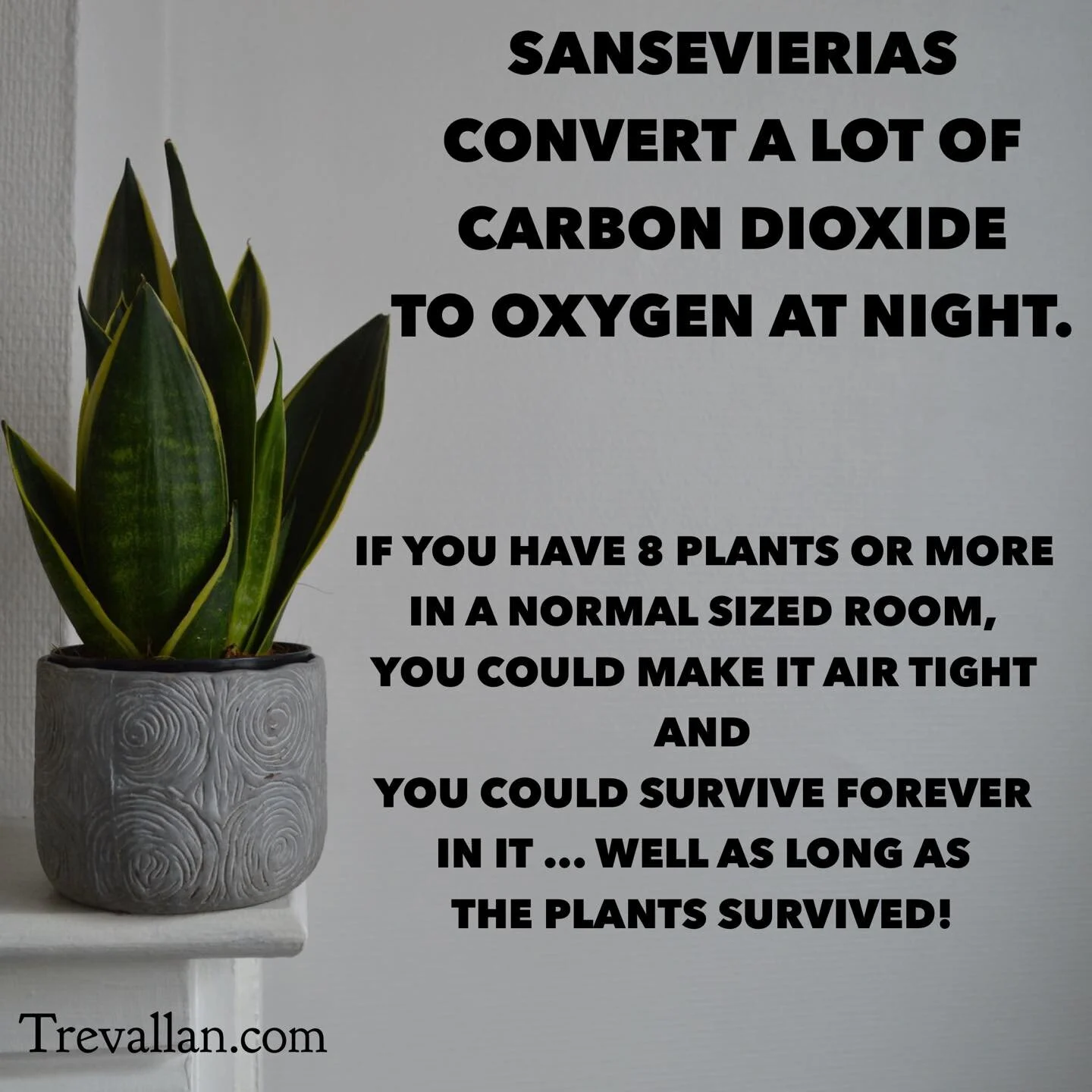
Keep their leaves clean and free from dust and grease. I only tend to fertilise mine with an organic slow release fertiliser when I split them, which I only do when they break the pot they are in.
If you've never had any luck with indoor plants, this is the plant for you. I know you might think these are old fashioned and uncool, I was the same, but now have several at home and love them to bits. Why? They’re a large chunky plant that will always look good, survive low light and not need care. I have them growing where I couldn’t get any other indoor plant to grow and they look amazing so why not up your indoor plant game and get your hands on a chunky Dracaena trifasciata

Indoor Plants
A gardening passion of mine is making Indoor Plants easy and why wouldn’t I when it's the biggest gardening craze since well, the 70's really!
A gardening passion of mine is making indoor plants easy - why wouldn’t I when it's the biggest gardening craze since, well, the 70's really! It's not the millennial generation any more, it’s the insta indoor gardener generation.
Really though, who can blame people for jumping on board with this amazing, not so new, craze? Who doesn’t want to be surrounded by lush green foliage inside and out?
We have decreased our yard size and increased our house space. We are on average spending more time indoors than we did ten years ago, so it's no wonder people are trying to beautify their indoor space with greenery.
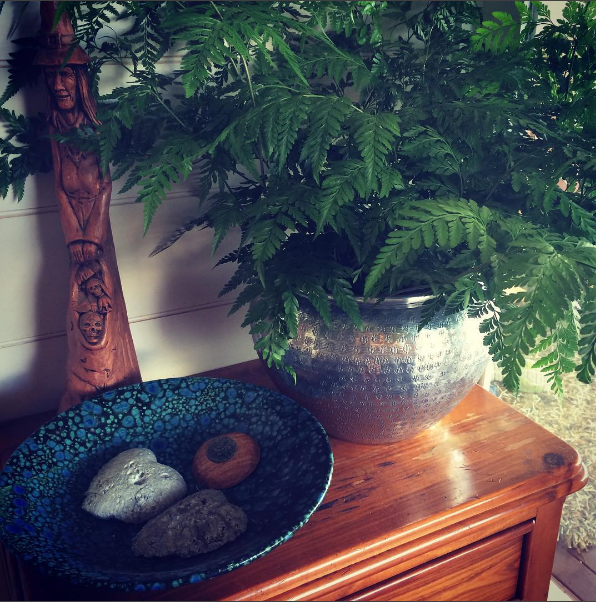
When done right, indoor plants completely change a way an indoor space looks and feels.
How many of us have instantly fallen in love with a room in a magazine? We think it’s the furnishings and the light, but I bet that space also has greenery.
For over 50 years scientists have been researching why indoor plants make us feel good. One reason is that plants make the indoor air cleaner. Volatile Organic chemicals are found in most household products – paint, furniture, cleaning products and fake air fresheners. Being volatile means they can easily become vapours or gasses, which in turn, can contaminate our air and be detrimental to our health.
Concentrations of many VOCs can be up to 10 times higher indoors than outdoors and can be even more concentrated in enclosed, air-conditioned offices.
It is believed a 3x4m room, just one healthy 200mm plant can reduce VOCs. To reduce VOCs by up to 80% you need at least ten large house plants.
However, indoor plants do more than purify the air.
Research has showed that there is also a link to our mental health and plants. When we are surrounded by plants, our mood and concentration improves, we are more productive and we interact more positively with others.
Research has also shown that although one plant doesn't really cut it in improving our mental health, when we start creating that "look" with more plants, wellbeing increases significantly. In fact, the greater the mix of plants and sizes, the better the benefits.
So indoor plants really do make us feel better. The science is there. It's not a crazy phase of the 70's that’s back in fashion. It’s a life necessity. However, the trick with indoor plants is to never give up. I thought I had my indoor plant game sorted, then I moved and my new house is providing both challenges and some really interesting wins.
Sometimes the most fashionable plant may not work for you and that's ok. It's about finding indoor plants that suit you and your lifestyle.
I can't wait to bring you inside to my indoor plant garden, and be sure to follow my indoor plant blogs for more information

Kalanchoe
Nothing kick starts you like the vibrant shades of the Kalanchoe. These hardy plants are perfect for giving your garden some TLC during winter.

With the onset of winter, we all need a kick start to get out in the garden. Nothing kick starts you like the vibrant shades of the Kalanchoe and these hardy plants are perfect for giving your garden some TLC during winter.
Kalanchoes are one of the prettiest bushy succulents. They belong to the stonecrop (Crassulaceae) family, which is the same family as the Jade plant or money tree. Kalanchoes are the ultimate winter plant whether it is for your garden or pots.
These glorious plants flower from June through to September, sometimes even longer. Kalanchoe flowers are best described as masses of small bouquets of starry, four petalled flowers that develop at the end of a stalk. The vivid colour of the flowers - hot pink, bright yellow, brilliant orange and intense red make a dramatic statement during the bleak cold of winter. In the past, the flowers have only been available in single form, but in recent years, a double flowering Kalanchoe has been released and is available in all the vibrant colours, hot pink being my favourite.
Kalanchoes have a compact habit and their leaves are oval with scalloped edges. They usually have lush green foliage, but some varieties have grey leaves, which can actually add a lovely contrast to a dull spot in your garden, or brighten a boring pot.

Kalanchoes are a succulent that can grow anywhere and are extremely hardy. They don’t mind whether they are grown in full sun or shade, so are perfect for shady balconies or the western side of the house. They don’t mind if they are left inside while they are flowering or if they spend their life outside. They look magnificent mass planted in the garden, or as a specimen plant in a pot. They even look fantastic in a hanging basket.
Brown or green fingered, Kalanchoes are sure to survive at your house. These beauties don’t need much water and would much prefer to be dry than wet. A good watering once or twice a week is all that is needed to keep these plants looking beautiful. They don’t like to sit in water, so make sure that if planted in a pot, their saucer isn’t constantly full or if in the ground, it is a well-drained area. Try planting in a clay pot with Searles Platinum potting mix as sometimes roots in plastic pots tend to sweat during the warmer months, which can lead to an untimely death.
Kalanchoes will thrive if Organic Link is used every three months and Triple Boost is applied every two weeks. If by chance insects attack your kalanchoe, trim off the affected foliage and spray with Eco-Oil (organic pesticide) or Neem Oil. Don’t fret though, these plants are tough and should survive even if they are only attended to rarely.
Flowering kalanchoes brighten any cold bleary winter’s day, so give your life and garden some TLC this weekend by getting outside with your morning coffee and enjoying the colours of summer whilst wearing your Ugg boots!

Kokedama
Kokedama is a style of Japanese bonsai made by taking a plant out of its pot and into a ball held together with a unique soil mixture, moss and string.
Viola hederacea’s made into kokedamas at Trevallan
Kokedama is a style of Japanese bonsai made by taking a plant out of its pot and turning it into a ball held together with a unique soil mixture, moss and string.
Trevallan's Kokedamas can be hung outside in full or part shade, and some are perfectly suited to indoors.
Trevallan stocks a range of Kokedamas, such as Native Violets, Ficus Pimula, Parlour Palm, Brazilian Walking Iris, Ficus Fiddle Leaf and Anthuriums .
How to look after me
When the sphagnum moss feels dry to touch and the ball is light, I soak them in a bucket of water for about ten minutes. If it’s really hot, you may need to do this more than once a week. If it’s cold, you may only have to do it once a fortnight.
Alternatively, similar to your other plants, you can just water them with a hose or watering can.
If my Kokedamas are inside, I like to sit them in a bowl and top the bowl up with water.
Where to put me

Trevallan's kokedama
Some of Trevallan's Kokedamas come with their own hanger. These can be hung outside in shade or part shade, maybe under a tree or on your patio. They look fantastic as a group.
Some Kokedamas are perfectly suited to indoors and can be hung from the ceiling, or Trevallan's handmade Timber Kokedama Stand.
If hanging isn’t an option, you can sit your Kokedama on a plate or in a bowl. The sphagnum moss will be wet most of the time, so be sure to protect your furniture.
Kokedama’s are definitely worth trying - remember, not every plant needs to be potted!