Find Us:
77 Fernvale Rd
Brassall QLD 4305
(07) 3201 8630
Open:
Tue-Sun 9am - 4pm
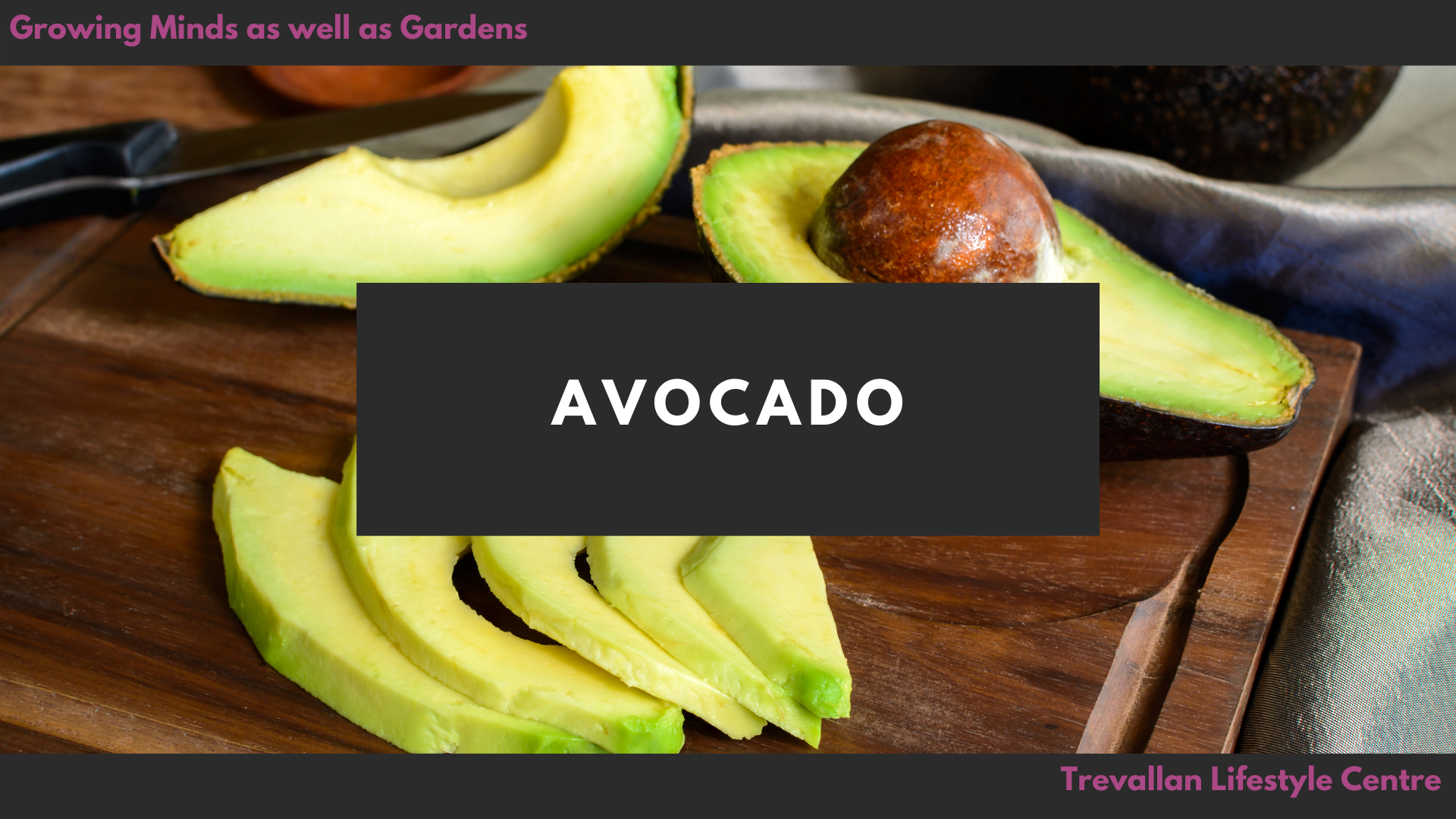
Avocado
Grow your own Superfood at home. Avocados are easy to grow if you know how.
Did you know that avocados are the only fruit apart from olives to contain monounsaturated fats? Monounsaturated fat is a healthy fat. Yes there is a thing called healthy fats! Healthy fats help you absorb essential fat-soluble nutrients (such as vitamin E), reduce the risk of developing Type 2 diabetes, help maintain a healthy heart and promote healthy skin.
It’s not just the healthy fats that make avocados so good. There are nearly 20 vitamins and minerals in this nutrient dense fruit. Avocados can help keep your immune system healthy, support mental performance, combat tiredness and even support a good mood.
They are not only a delicious way to ensure you are getting optimum nutrition per day, research shows adding avocado to a salad can increase your ability to absorb nutrients from other ingredients.
But avocados can be expensive in the shops….. so let’s grow our own!
Avocados love warm tropical climates. While you can easily grow an avocado from seed it is not recommended as seed grown avocados may not fruit or fruit successfully every year. It is always best to grow a grafted avocado, grafted by a reputable grower.
Avocados can grow over 6m in perfect conditions. Many of us could not handle this in our backyards which is why we recommend the dwarf growing varieties of avocados or keeping your avocado tree trimmed.
Wutrz and Fuerte are our two favourite varieties for growing in this area.
Avocados don’t need another avocado to fruit as the flowers are botanically classed as ‘bisexual’, carrying both male and female reproductive organs. However having more than one is beneficial and having both Type A and Type B flower types is even more beneficial. They tend to fruit more vigorously when they have friends.
Avocado flowers open twice over a two-day period - the first day as a female and the second day as a male.
Type A avocado flowers are ready to be pollinated in the morning, but any blossoms flowering in the afternoon are releasing their pollen.
Type B therefore, release pollen in the morning and are ready for fertilising in the afternoon.
This means the crawling and flying insects trying to harvest the pollen don't always get to their female counterparts to fertilise the fruit. Luckily, the trees usually flower for up to a month, so don’t panic if you can’t find type A and Type B. Just one Type will be enough to get fruit. If you plan on feeding the neighbourhood getting Type A and Type B might be a good idea. Wutrz are a Type A and Fuerte are classed as a Type B both grow fantastic in Ipswich region.
When growing either of these trees make sure it’s in a full sun position, well draining soil and protected from frosts. We recommend using good quality garden mix like Searles Garden Mix or excellent quality potting mix like Searles Platinum mix.
The trees should be fertilized every three months with a good quality organic slow release complete fertiliser like Organic Link. A liquid fertilizer, like Triple Boost should be applied fortnightly through the growing season. A good liquid trace element mix like Bio-Trace should be given about twice a year. Plant health is very important for best fruiting results.
Avocado – Wurtz
Wurtz Avocado is a gorgeous small tree perfect for pots or small gardens. It naturally small and only grows to around 3m. While it may be small in statue it still produces a consistent, heavy crop of beautiful fruit! It has pear-shaped fruit with dark green skin and can fruit from August till October.
Wurtz are classed as a Type A pollinator so would be beneficial to plant a Type B Avocado.
Get your mini orchard going in your backyard today.
Avocado - Fuerte
Fuerte is marginally oily with a rich, creamy flavour with notes of hazelnuts and is often hailed as the tastiest of all avocados. This B-Type avocado not only improves the pollination of A-Type varieties such as ‘Hass’ and ‘Wurtz’, but it also produces delicious pear-shaped fruit of its own from winter into spring. It has easy to peel fruit that crops better every second year. One of the best cold tolerant avocardos.
Fun Fact : The Fuerte avocado got it’s name as it was the only variety to survive the great freeze of 1913 in Los Angeles, California. Fuerte, means “strong” in Spanish. This avocado cultivar built the Californian avocado industry until the 1930s when Hass took over as it had a thicker skin (not better tasting) and therefore could be transported better.

Blueberry
Blueberries are one of the yummiest to eat fruits but can be a little tricky to grow. Here’s some great tips to get yours looking and fruiting fantastically.
Hands up who has tried to grow a blueberry before?
Ok, now hands up who grew one successfully?
I know I have tried and failed. Not failed as in to death do us part. Failed as in I got sick of looking at a stick that had three blueberries on it!
I persevered. I can now give you some great growing tips on how I got mine to look so good.
Blueberries like a position that receives full sun most of the day but if you live in Ipswich, like me, and temperatures in Summer can reach over 40C, it is recommended that plants should get a little afternoon shade.
I have found growing my Blueberries in pots is a lot easier than the ground. They are an acidic loving plant and I find my local soil just isn't good enough.
I always use excellent quality potting mix, like Searles Platinum Potting Mix but add some (about a cup or two) course bark (10mm-25mm in size), usually just the Searles Orchid Bark is fine, to provide an open potting mix for root development. Blueberries produce masses of fine roots which mat together. Without an open potting mix all Blueberry varieties will only have a life of around 2-3 years in pots. This mix will extend the plants life well beyond this. Mulching the top of the pot is imperative to minimise drying out. Blueberries hate wet feet but fruit will taste bitter if they dry out too much. Mulch seems to help with both these problems.
Your Blueberry should be fertilized every three months with a good quality organic slow release complete fertiliser like Organic Link. A liquid fertilizer, like Triple Boost should be applied to the foliage fortnightly through the growing season. A good liquid trace element mix like Bio-Trace should be given about twice a year. Plant health is very important for best fruiting results.
I have grown a number of different Blueberries in the past. My current favourites are Blueberry Burst, Sunshine Blue and Gulf Coast.
BlueBerry Burst

Saying I'm excited about BlueBerry Burst would be an understatement. This Australian bred, naturally dwarfing evergreen blueberry (1m high and 75cm wide) is said to grow and fruit WELL anywhere in Australia.
Blueberry ‘Burst’ has been successfully trialled in both hot and cold environments throughout Australia and humid and dry areas too.
I have been successfully growing mine in a large pot in Ipswich for years and my friends grow theirs at Mt Marrow. Both have suffered through hot, humid summers, cold wet winters as well as hot dry summers, cold dry winters.
It has exceptionally large fruit and a very high yield and it still tastes amazingly sweet kind of like, you know a blueberry!
For those of you living in a warmer climate fruiting should start in July and those in a cooler climate around late august. Fruiting concludes within 3-4 months.
Sunshine Blue Blueberry

Sunshine Blue has it all. This semi-dwarf, versatile shrub features showy hot pink flowers that fade to white in spring, with delicious, sweet blue fruit during summer.
A wonderful shrub that is easily grown, producing abundant amounts of fruit for eating or use in pies and sauces.
Sunshine Blue tolerates higher pH soils better than many other blueberries and it is self-fertile.
It is a Southern Highbush with the low chilling requirement of 150 hours making it suitable for the subtropics, but is also surprisingly cold-hardy and a wonderful addition to patios and gardens in cooler areas.
Flowers October to November
Gulf Coast
Gulf Coast Blueberry is an exceptional hardy Blueberry, perfectly suited to the subtropics.
It has excellent flavour, firmness and good picking scar. A vigorous upright bush with moderate toughness and good tolerance to root rot.
It has a late fruiting season October, November, December.
While Blueberries are self pollinating they always produce better and more abundantly if they are surrounded by friends!

Bloomin' Fabulous
Potassium Sulphate or Sulphate of Potash is commonly called Potash. It is an essential element necessary to the lives of all plants.
A common question I am asked is "why didn't my fruit trees fruit profusely or if they did why was the fruit misshapen?" Or "why didn't my camellias and azaleas flower as well this year?" Or even "why are all my coloured foliaged plants like crotons and dracaenas losing their colour?"
The answer is usually quite simple - Your garden just needs some TLC and maybe a little Potash!
Potassium Sulphate or Sulphate of Potash is commonly called Potash. It is an essential element necessary to the lives of all plants.
It aids in disease resistance and frost protection by strengthening the plants cell walls. It helps in seed and root development. It encourages strong new growth and helps with the formation of flower buds and fruit.
Potash can improve the quality and the colour of flowers and enhances the formation of proteins and sugars in fruit. Potash can even help plants with slender stems and large flower heads such as Iceland poppies and gerberas hold their heads erect.
Potash defective cues can be seen in a number of ways in your plant. Your plants might be showing signs of overall weakness especially in its stem. It could have yellowing leaf margins and grow more slowly. It could also be disease prone and its fruit and flowers will be small and poorly coloured and sometimes tasteless.
Don't confuse a potash deficiency though with an unhealthy plant. Always make sure you have given your plant some complete slow release organic fertiliser like Organic Link and a Bio Trace first.
Complete fertilisers, whether they are chemical or organic, usually contain potash. Organic Link contains potash. An N:P:K ratio can usually be found on the fertiliser label. A very quick explanation of the N:P:K ratio is - N stands for Nitrogen (greening, growing), P Phosphorus (roots) and K Potassium (fruiting, flowering).
If you use mainly a manure based fertiliser like blood and bone or chicken manure you will need to add potash as these products don’t naturally contain it.
Potash also is available by itself in a liquid form and a granular form.
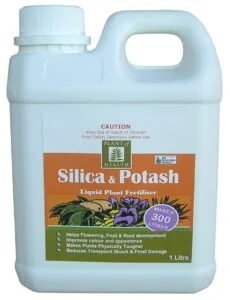
The liquid form is added to water and used as a foliar spray. Used like this it is quick acting but not long lasting and needs to be repeated on a fortnightly basis. This is best for promoting flowers especially on annuals. I use Plant of Health's Potash and Silica.
The granular form is added to the soil and watered in. The granular is slower acting but lasts a lot longer. This is best for correcting deficiencies, promoting fruit and stimulating coloured foliage. We use Searles' Potash.
This weekend I want you all to get some granular potash and go a little silly in your gardens.