Find Us:
77 Fernvale Rd
Brassall QLD 4305
(07) 3201 8630
Open:
Tue-Sun 9am - 4pm
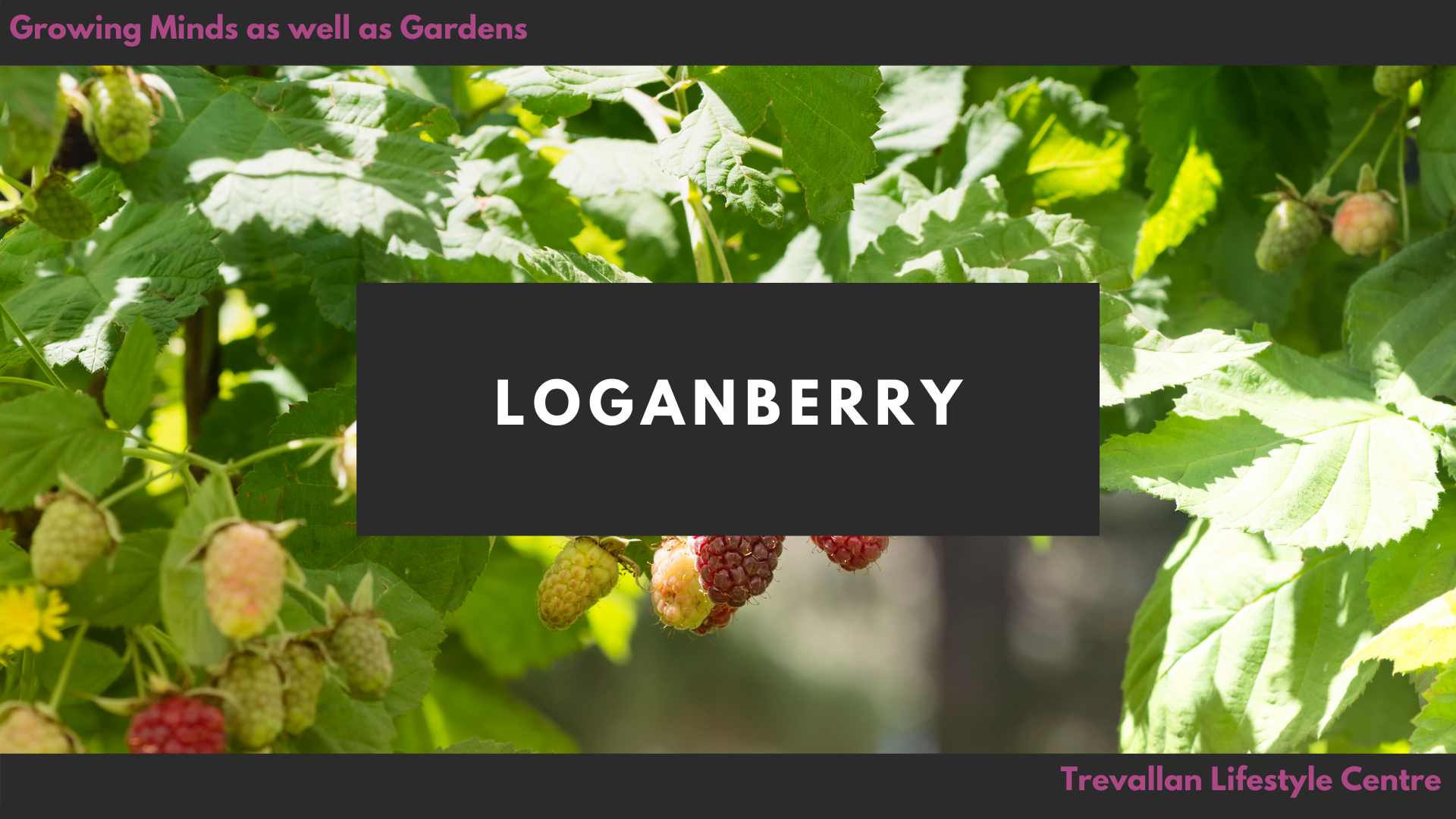
Loganberry - The Accidental Berry
Discover optimal Loganberry growth techniques, effective fertilization methods, and solutions to common problems in our informative blog. Enhance your harvest with expert tips!

If you are after something a bit different the loganberry may be your answer. The loganberry originated due to an accidental cross between a raspberry and a blackberry. The plant is named after the horticulturist who first created it, James Logan.
Loganberries look a lot like blackberries, or very dark raspberries depending on their variety.
Even though loganberry plants are very hardy and are more disease and frost-resistant than other berries they are not very popular with commercial growers. The two main reasons are - the bushes are thorny and the berries are usually under the leaves so its very labour intensive to harvest and the berries don't mature at the same time making it hard to get a complete harvest at once.
Loganberries are therefore more commonly grown by the suburban gardener.
Growth and Harvest
A loganberry bush usually produces about ten canes or vines. The canes tend instead to vine more like its blackberry mum and will need a bit of support to keep them from getting out of control. The vines aren’t as flexible as the blackberry though, so they don’t bend well. It is recommended to train loganberry vines up a trellis rather than along horizontal wires. The trellis should be placed in the ground at the same time as planting so as not to damage roots at a later stage.
The great thing about Loganberries is that the fruit doesn't ripen all at once, they can fruit for about two months, generally from mid-summer until mid-autumn. The berries are harvested when they are a deep purple colour. Amazingly each bush can produce 7 kg to 8 kg of fruit a year. The worst thing is you may need to wear gloves and long sleeves so the thorns don't bother you when harvesting!
Once you've harvested your berries use them up quickly as they will only stay fresh for around 5 days in the refrigerator. For longer storage, freeze your loganberries and use them in cooked dishes. Loganberries can be used in juice or in jams, pies, crumbles, fruit syrups, and country wines.
After you’ve picked your berries, cut the canes back to ground level. A big bush doesn’t mean more berries, so its better to keep it under control, ten to 12 canes will still produce well.
Loganberry vines can be brittle so choose a sunny location that is sheltered from the wind. For a successful crop, it is advisable to choose a fertile soil location for your loganberry trees, as is generally recommended for fruit-bearing plants. Nevertheless, loganberries display a notable tolerance for poorer soil conditions. If your soil is of lower quality, enhancing it with a quality organic garden soil or compost during planting can be beneficial.
Loganberries, like most plants, need regular watering and a good fertilise with a complete organic fertiliser, like Organic Link at the turn of every season. If they aren't producing much fruit try adding some granular sulphate of potash in spring.
When growing any fruit trees in Queensland it is advisable to have an active fruit fly trap going all year.
Pests and Diseases
Loganberries are generally quite resistant to disease and pests, but there can be a few problems.
Raspberry leaf spot fungus starts out as small spots on the upper surface of young leaves. As the lesions grow, the infected tissue may fall out, leaving holes in the leaves. Badly infected leaves curl downward at the edges and drop prematurely. Spray your plant with a fungicide (eco-fungicide is a great organic fungicide), cut out the spotted leave and any infected leaves that have fallen off should be raked away and destroyed.
Dryberry is caused by a tiny mite that lives in the buds of the plant. The mites will start to feed on the fruit as it develops, leaving you with some berries with dry or dead sections in them. It will need to be treated with an insecticide around the time the fruits are starting to form to combat the problem. Organic insecticides would be eco-oil or eco-fend. Regular treatment with Neem oil may also reduce the problem.
If you don't mind a few thorns Loganberries would be a great addition to your home orchard.

Grow your own Tea
We can easily grow Camellia sinensis in Ipswich. We just have to understand they will grow a lot slower than they do in their natural habitat. We may only get one yield a year out of our Camellia sinensis.
Do you know that almost every type of tea comes from a Camellia? That's right tea comes from the plant Camellia sinensis.
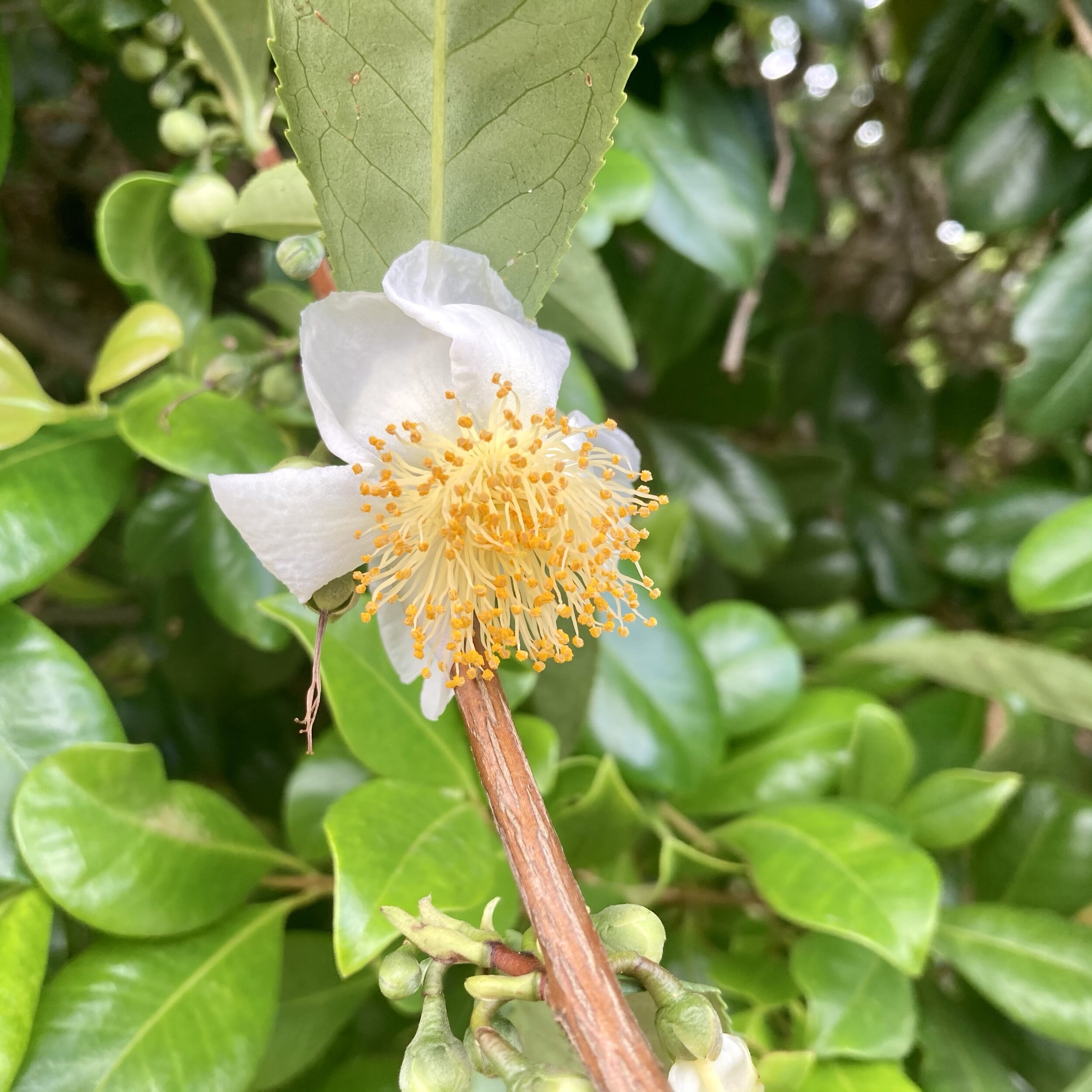
Camellia sinensis Flower
Camellia sinensis var. sinensis and Camellia sinensis var. assamica are two major varieties grown today. Camellia sinensis are believed to have originated in the borderlands of north Burma and southwestern China.
Camellia sinensis are evergreen shrubs. The leaves are glossy green with serrated edges. It usually forms cute small white flowers with bright yellow stamens in spring but I have found in our climate it can flower from spring through to winter. In cultivation flowering is halted by the consistent plucking of new growth, forcing the plant to constantly make more leaves not more flowers.
After flowering Camellia sinensis can fruit. This fruit has a hard green shell and a single, round, brown seed, these seeds can be used to make tea oil. Tea oil has huge huge potential in the cosmetic industry and medical industry due to its natural healing and nutritional properties. It is also commonly used in Chinese cooking.
Camellia sinensis sinensis (China)
Camellia sinensis var. sinensis is the main tea plant in production in China. It naturally grows at high altitudes on mountain slopes. In its native habitat it can grow to 4.5m tall and produce leaves up to 5cm long. The growing season may be short in it's native mountainous area and the yeilds small but the tender leaves yield a sweeter, less astringent tea.
When grown in cultivation the plant is pruned to about 1m high with a flat top surface to allow easier plucking of the new growth. In most areas the growing season is only half of the year as the plant is dormant during Winter. These plants will generally only yield about five pluckings a year. Due to its dormancy during Winter, where its storing up all its nutrients, the first spring "flush" of new growth provides some of the finest teas on earth with the highest concentrations of desirable flavours and essential elements that make tea a health tonic.
Camellia sinensis assamica (Assam, India)
Camellia sinensis assamica is native to the Assam region in Northern India (near boarder of Burma and China). This strain of Camellia sinensis loves high humidity, warm temperatures and lots of rain. If left alone the Camellia sinensis assamica can grow up 15-20m high and its leaves can be 20cm long. Under perfect conditions Camellia sinensis assamica can be harvested every 8 to 12 days all through the year. Due to the tremendous yields, it is the preferred crop in Northeast India, Sri Lanka and Africa. The Camellia sinensis assamica leaf is ideal for producing strong, malty, black teas. Other Chinese teas requiring lengthier production, such as oolong and pu'erh, are also made from the larger leaves of the Assamica plant.
We can easily grow Camellia sinensis in Ipswich. We just have to understand they will grow a lot slower than they do in their natural habitat. We may only get one yield a year out of our Camellia sinensis. Due to their slow growth rate, Camellia sinensis would be happy to stay in a pot or they could be used as a low hedge. With little effort Camellia sinensis can easily be trained to grow thick and neat, they really only need to be pruned once a year, when you do your tea harvest!
To promote good growth and some flowers I would be fertilising with Organic Link at least twice a year, just before flowering and just after. Throughout the year I also think its a brilliant idea to regularly liquid fertilise. I like to alternate between Triple Boost and Silica and Potash. I find Camellia sinensis aren't prone to a lot of insects or diseases if kept healthy. I usually mix neem oil with my Triple Boost Liquid Fertiliser to promote strong healthy growth. If by chance I get an insect attack I find Eco-oil or Eco-Fend can usually solve the issue.
Camellia sinensis can tolerate both full sun and full shade but the best spot is a partially shaded area. As long as they are planted into good quality potting mix or garden soil and mulched correctly Camellia sinensis can be one of the most robust drought tolerant plants around. They do prefer regular watering's though to promote healthy new growth.
If you've been looking for something a little different to grow in your garden this year, I'd suggest Camellia sinensis are a great place to start.
If you love your tea but can't wait to grow your own, Trevallan also stocks Tranquil Tea's Ipswich Breakfast Blend

Grow your own Coffee
Have you grown and made your own coffee? Ultimately these babies can produce beautifully scented white flowers, fruit that can be eaten raw and then the ultimate seeds that make the coffee.

Did you know that the coffee tree shares the same family as cocaine?
Coffea arabica also known as the Arabian coffee, is a species of Coffea.
It is believed to be the first species of coffee to be cultivated and is said to currently represent over 60% of global coffee production.
The other main coffee producer is and Coffea canephora, known as "Robusta"Coffea arabica is one of the world's most valuable crops and is the preferred coffee of choice as it is sweeter in taste.
Coffea canephora, has a higher caffeine content.
C. arabica originated in the highlands of Ethiopia and the Boma Plateau of Sudan.
According to Wikipedia, The first written record of coffee comes from Arab scholars, who wrote that it was useful in prolonging their working hours.

Coffea arabica 'First Fleet' Taken by Jerry Coleby-Williams
Coffea arabica can grow quite tall but there are dwarf varieties available. You can also just prune your Coffea arabica to size. Jerry Colbey-Williams recommends pruning your coffee tree to produce a crop that ripens evenly, to protect the cherries (fruit) from fungal damage, and to keep plants to a suitable height for picking. Jerry states that “Coffee plants flower on the current season's growth, not on older stems. Prune off all weak, dead or crossing branches. If necessary, thin flowering stems so all of them are exposed to good sunlight.”
Coffea arabica prefers a position that gets a lot of warmth but not too much direct summer sun. I have found this plant will burn in full sun and fade in shade. We have it in a number of positions at Trevallan and it loves early morning sun and all day warmth or late afternoon sun and all day warmth. I’ve even heard of people growing it in a full sun position inside. You know the place where the sun streams in through the windows! Coffea arabica hates the cold and during winter really loves a warm spot. It likes regular watering and hates drying out for long periods. It also hates over watering. Regular water is key! It can also be susceptible to insects if allowed to get unhealthy. I find fertilising mine regularly with Organic Link and a regular Liquid feed with neem and Triple Boost keeps ours looking good. Also great soil - free draining and nutrient dense. Jerry Colley-Williams has many posts on his Facebook page about coffee and all its different uses. Like, did you know you you can eat the ripe outer flesh? Jerry says it’s sweet and antioxidant rich. It can also be brewed to make tea which is said to have anti-inflammatory properties? A tea from coffee, mind blown!
Ultimately these babies can produce beautifully scented white flowers, fruit that can be eaten raw and then the ultimate seeds that make the coffee. It’s a long process and not one I would like to do to get a cup of coffee in the morning but at the same time an exercise I would like to experience
Have you grown and made your own coffee?
Coffea arabica now available at Trevallan

Finger Lime
Finger Limes - Little balls of goodness on your tongue and a sweet Lime explosion happens in your mouth, giving a unique flavour sensation.
Finger Limes are like our national treasure.
I always liken the little balls of tasty goodness to popping candy that I used to have as a kid.
Here’s this weird long fruit that you cut open to reveal what looks like caviar. You put these little balls of goodness on your tongue and a sweet Lime explosion happens in your mouth, giving a unique flavour sensation.
But to get to this amazing point we all need to remember the saying be thankful the thorn bush has roses!
To me Finger Lime bushes are spindly and exceptionally prickly. There really isn’t much more to say about their looks. As my mother always taught me if you can't say something nice, don't say anything!
As for care and attention, these guys are very hardy as long as you get it right! They Like a very warm protected position. This plant isn’t a fan of the cold and it also hates the burning sun. You have to remember that these plants are native to the rainforests of the border ranges of SE Queensland and Northern NSW.
I personally have found I can grow them better in a pot but I know a lovely family that is growing them by the tens at Pine Mountain in the ground.
They love a really nutrient dense soil so fertilise on the turn of every season with an excellent quality all round organic fertiliser like Organic Link.

Finger Lime Chartreuse
I have found it’s best to keep them trimmed as they can get a little, dare I say it, ugly !
White Autumn flowers are followed in Winter and Spring by slow-growing finger-shaped fruit containing glistening ‘citrus pearls’. The fruit is highly nutritious, rich in Vitamin C and high in antioxidants. Finger Lime fruit doesn’t ripen well off the tree, so pick only fully ripe fruit – these will feel full and detach easily. When opening the fruit, avoid getting oil from the rind onto the pearls, as this can affect the flavour.
Varieties Trevallan Stocks
Red Champagne variety of Finger limes produce fruit from December to March and they say the flavour is like spiced apple and apricot with a berry aroma... sounds like a good wine description!
Chartreuse has a subtle citrus flavour and is less bitter than other finger lime varieties. It has green fruit with a pale green/yellow flesh. It is said to be ideal for salads, desserts and seafood. Chartreuse has a long fruiting season
Byron Sunrise is a dark skinned finger lime with tangy light pink coloured citrus pearls that strengthen in flavour when the fruit is cut and exposed to the air.
Crystal variety has very large fruit and can be vigorous, enabling the possibility of high yields per tree. The fruit is green skin with light green vesicles, bursting with flavour.
Seriously while these plants aren’t the prettiest plants they have a unique look that can work in many garden designs especially as containerised feature trees. Come into Trevallan today and get your own native fruit tree!

Going Bananas
Bananas, we can finally grow them in our backyards, legally. Which variety is best for us and how do we grow them successfully?
We are going Bananas at Trevallan
We have some beautiful looking bananas at Trevallan. This range of banana have been selected for not only being able to grow and fruit well in the home garden but also for their ability to produce fruit under cooler conditions.... we all know sometimes we can get cold here in the Ipswich Region.
Varieties of Bananas Trevallan Stocks

Dwarf Red Dacca produces small, very sweet bananas with a creamy texture. The skin changes from burgundy to orange as they ripen and the flesh is pale orange-pink.
Dwarf Cavendish produces heavy crops of full sized, sweet bananas with a creamy texture. The tree is super dwarf reaching a maximum height of only 2m so it is perfect for pots, so it can be grown on balconies and yards.
Lady Finger produces small bananas with a rich, sweet flavour and creamy texture and which keep well. Great for fruit salads since the flesh does not brown when cut
Blue Java fast growing, cold tolerant. Fruit has the flavour and consistency of creamy vanilla ice cream or custard.
PLANTING INFORMATION
Bananas require deep, rich soil which is well drained, in a position which is in full sun for most of the day.
Let’s be honest most soil in Ipswich isn’t that good unless you’ve been really working it for the last few years. So you will really need to work your soil well before you plant. A couple of bags of Searle’s Compost, some granulated Soil Soaker and a couple of handfuls of Organic Link will really enliven the soil before you plant.
The Dwarf varieties can be planted in very large pots. For this I would use Searles’ Platinum Potting Mix
They suggest a north facing position is best for your banana and make sure if you get frost you can either protect it by throwing a cover over it or it’s in a protected position.
After planting, water thoroughly and apply a thick layer of organic mulch to the worked area, keeping it away from the stem of the plant. I find sugar cane is best.
Bananas are heavy feeders and as the plant grows it will need a good feed about every two to three months. I would be using Organic Link.
Remove dead leaves regularly and keep the tree clean.
WHEN TO HARVEST
You will know the bananas are ready to be harvested when the bananas lose their ridges. They will become more rounded, softer looking.
The flowers at the end of the bunch will go dry and crumbly is an indication as well.
MOST IMPORTANT INFORMATION TO KNOW ABOUT BANANAS
It may take 2-3 years for the first fruit to be produced.
Suckers will appear from near the base of the main stem.
You will need to select one to be the next main stem and remove the others.
After the fruit has been harvested the stem that had the fruit on it should be cut down.
The retained sucker will replace it as the main stem.
This process is continued indefinitely
Bananas don’t need another tree to help pollinate the flower so one Banana tree is enough but since variety is the spice of life why not grow all three if you have the space.

Fruit Fly
Two words that can strike fear into any fruit tree or vegetable grower – FRUIT FLY! How to deal with it Organically
So you want to know why your tomatoes get black spots and rot away or why you lose most of your peach crop to black spots and maggots.

Two words that can strike fear into any fruit tree or vegetable grower – FRUIT FLY!
Whether you have one fruit tree in a pot or a commercial orchard Queensland fruit fly can have devastating effects.
These files can sting up to 100 different varieties of fruit and vegetables such as Peach, nectarine, grapefruit, pear, avocado, grape, cumquat, apricot, orange, fig, tomato, eggplant, passionfruit, lemon, apple, loquat, chili, capsicum and strawberries.
Queensland Fruit Fly is an Australian Native insect. This native insect though is recognised as one of the world's worst fruit pests - it used to be estimated that it cost Australian fruit growers more than $100 million each year.
For many years it was just Queenslanders that used to have to suffer the trials of Fruit Fly devastation. Unfortunately fruit fly has not been well managed and many parts of NSW and Victoria have now also been declared Fruit Fly zones.

The adult Queensland Fruit Fly is only about 7 mm long and reddish brown with yellow markings. They lay their eggs in ripe fruit, their babies - maggots then hatch from the eggs and tunnel through the flesh of the fruit turning it into a brown, filthy inedible pulp. Affected fruit is recognised by a small sting mark that becomes discoloured and rot develops around.
Whether you grow one fruit tree or 100 we are all responsible for keeping this pest under control.
Some easy things to do
prune your fruit trees regularly, keeping the tops of the trees to a manageable height which makes fruit picking easier.
Remove any ripe fruit from fruit trees before it has a chance to fall to the ground
Most importantly collect fallen fruit from the ground and preferably place it into a black plastic bag and leave in the sun for 3-7 days to kill any maggots in the fruit.

Another easy way to help reduce the amount of fruit files is to use a trap. Searles Fruit Fly Trap attracts and kills the male fruit fly.
If there are no males in the area the female is unable to reproduce and moves on. The trap has a wick inside a container. The wick contains the pheromone of a female fruit fly in season, coupled with an insecticide. Traps are hung in an area near the fruit trees and can do an area of up to 500m. The wick lasts for three months and a replacement wick can be bought.
I change my wick at the turn of every season. Fruit fly usually have a dormancy period during the colder months but I have found our winters aren't really affecting them like they used too so I keep my trap going all year long.
My first season of using this method I was catching a small vegemite container of Fruit Flies a week!
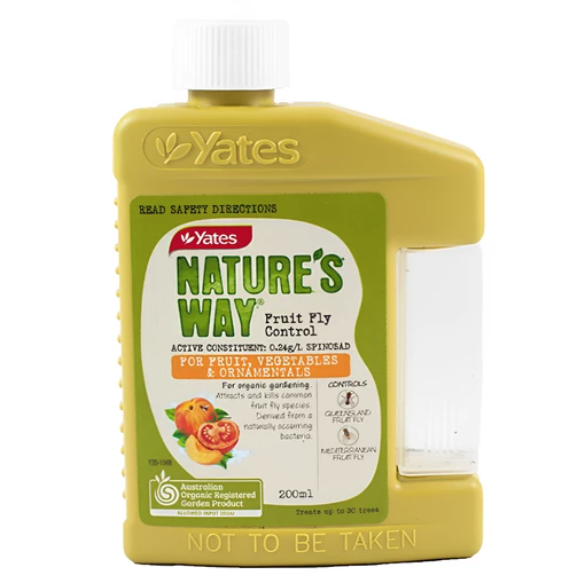
In conjunction with my trap I used to use eco-naturalure but this has now been replaced by Yates Nature's Way Fruit Fly Control. Yates Nature's Way Fruit Fly Control is a BFA registered organic fruit fly control spray for both male and female flies.
It combines specific food based attractants which target only fruit flies, and bacteria derived insecticide, spinosad, that leads to an almost instantaneous death.
You can also use fruit fly netting and fruit protection bags which are specially designed netting that you can use to cover your fruit trees or individual fruit.
I honestly believe that if every household had a fruit fly trap we could get on top of this horrendous outbreak.

What's wrong with my Citrus trees?
Citrus trees are prone to Leaf Curl and Leaf Miner. Here’s some organic methods to stop these issues.
Citrus trees are prone to Leaf Curl and Leaf Miner.
Both these problems are mainly caused by insects.
Leaf Curl can be attributed to sap-sucking pests like aphids, mites and psyllids who feed on citrus leaves by extracting the juices directly from transport tissues. As populations grow, they can cause deformations including curling and cupping in leaves, as well as discoloration.
Leaf Miner are another insect, moth larvae. Instead of sap-sucking, moth larvae tunnel through leaf tissues as they grow. These tunnels are highly visible on leaf surfaces, appearing as white or yellow lines.
I find the best way to deal with both of these pests is just trim off the affected leaves. If you wanted to spray BFA certified organic sprays like Eco-oil or Eco-fend would work. I find if I mix a little neem oil with my liquid fertiliser (Plant of Health's Triple Boost) and use it fortnightly it also reduces the harmful insect population. I try to work from a place of prevention is better than cure.
If your plants are badly affected a weekly spray for at least four weeks with Plant Care and Neem Oil, mixed together might be your magic pill!
Why Neem Oil and Plant Care?
Neem Oil is derived from the Azadirachta indica tree. When applied to insects and the plants they are eating, neem oil causes many insects to feed less, grow more slowly, molt less, and lose interest in laying eggs. Neem also suppresses the hatching of pest insects from their eggs.
Plant Care is like a vitamin pill for plants or when they’re sick or stressed. Plant Care contains natural liquid fish proteins, amino acids, liquid vermicast, fulvic acid, natural growth stimulants as well as a special blend of selected herbs and botanical extracts. Plant Care is a natural, non toxic foliar spray and can be used regularly on all plants, vegetables and lawns without the fear of NPK overload or plant damage.
Drought stress can also lead to leaf curl in citrus and is the easiest to remedy. If leaves begin to curl inward while retaining their green colour and the soil around your tree feels dry to the touch, you’re not watering enough. Step up your watering efforts and applying an organic mulch if you haven't already. If you are watering regularly then a soil wetter may be necessary. Soil Wetters help water and nutrients penetrate into the soil enabling the plants roots to pick up what they need.
Nutrient deficiencies can also lead to leaf curl. Citrus trees are very heavy feeders.
My citrus trees get Organic Link every three months and I try to liquid fertilise them fortnightly. I also like to give my trees a liquid fertilise with a complete trace element mix (I use Plant of Health's Bio-Trace) twice a year as part of my normal fertilising regime.
“Even if I knew that tomorrow the world would go to pieces, I would still plant my apple tree.” Martin Luther
I think the world would be a better place if we all took Martin Luther’s advice. We do not know what tomorrow will bring but we do know what we can do today for a better tomorrow!

Can you Grow your own Curry?
Curry isn't just one herb, it is a complex seasoning that varies from region to region and even from family to family throughout Southeast Asia. If you thought you could buy a Curry plant, think again!
Curry isn't just one herb, it is a complex seasoning that varies from region to region and even from family to family throughout Southeast Asia. Curry seasonings can even be vastly different depending on the season. During summer months, the seasoning is mixed with spices that cool the body and in winter, a different blend helps keep the body warm.
So what are the plants commonly called 'Curry Plants'? Are they even used in Curries?
Curry Leaf Tree or Sweet Neem (Murraya koenigi)
The Murraya koenigi leaves are the primary seasoning in the South Indian dosa, a crispy, thin, rolled pancake-like bread but it is also used in pickles, egg dishes, chutneys and many other Asian and Indian dishes and is known as “sweet neem” in India.
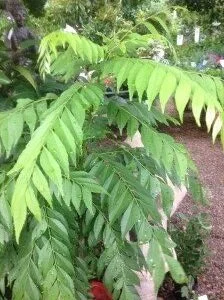
Curry Leaf Tree or Sweet Neem (Murraya koenigi)
Murraya koenigi is native to India and Sri Lanka. The leaf is the only part of the tree used in cooking and the raw, fresh curry leaf won’t really remind you of curry, but once the leaves are roasted in oil, the aroma and flavour can change remarkably, and the flavour is pleasant and delicious.
Even if you don't cook the Murraya koenigi is still a highly prized plant as its purely ornamental small, white flowers are highly fragrant.
It is a beautiful evergreen small tree that can be grown throughout Australia. Trees can grow up to 4m tall, in the warmer weather but it is advisable to prune back to a desired height of 1.5-2m. Pruning also encourages new growth and hence new leaves for harvesting throughout the year.
It requires full sun or semi shade position protected from heavy frosts. Ideal on warm northern side of buildings in cold climates.
The Curry Leaf tree requires reasonable drainage and regular fertilising. I use Organic Link every three months and Triple Boost regularly.
Curry Plant (Helichrysum italicum )
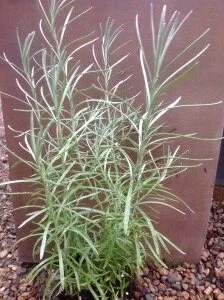
Curry Plant (Helichrysum italicum )
Although called the "curry plant" and smelling like the commercial curry powders, Helichrysum italicum has nothing whatsoever to do with this mixture of spices, nor with the actual curry tree (Murraya koenigii), and is not used as masala for curry dishes.
Helichrysum italicum grows naturally on dry, rocky or sandy ground around the Mediterranean. When growing at home try to make sure your plant is in free draining soil and full sun.
The leaves are grey with clusters of yellow flowers in Summer. These flowers are commonly used in dried flower arrangements.
The shrub can reach about 60 cm in height and can grow in pots or a garden bed. Like all herbs a good tip prune keeps the shrub looking neat and tidy. I usually fertilise at the turn of the season with Organic Link and Triple Boost regularly.
In the Mediterranean the young shoots and leaves of the Helichrysum italicum are used to flavour meat, fish or vegetable dishes. These shoots are then removed before serving. Many people don't like the actual taste of the plant as it has a resinous, somewhat bitter taste reminiscent of sage.
Do you have a Curry Plant or Tree?

The fruit is Perfect for Wine, I'll take two!
Beautiful tree with glossy, deep green leaves, small white flowers, and reddish young growth. Only four or five weeks after flowering the round, purple-black edible fruits are ready to harvest.

Fruit of Grumichama eugenia
The Grumichama is valued almost as much for its aesthetic elegance as it is for its sweet, cherry like fruits.
In its native Brazilian habitat, Grumichama are sometimes seen as a large tree reaching heights of up to 15 metres, however in most Australian home orchards it grows more slowly. Most plants will only become a small, bushy tree to about 6 metres high. This tree can easily be trimmed and kept at a much lower height of 3m.
It is a very beautiful tree with glossy, deep green leaves, small white flowers, and reddish young growth. Only four or five weeks after flowering the round, purple-black fruits are ready to harvest. The flesh of the Grumichama is soft, melting, and sweet like a cherry. The thin, delicate skin is also edible.
The fruits can be eaten directly off the tree, turned into jam or my personal favourite wine!
Its wood is sometimes used in carpentry, woodworking and turnery.
Can be planted in full sun and doesn't mind low temperatures. Fertilise with Organic Link every three months.