Find Us:
77 Fernvale Rd
Brassall QLD 4305
(07) 3201 8630
Open:
Tue-Sun 9am - 4pm

Fruit Fly
Two words that can strike fear into any fruit tree or vegetable grower – FRUIT FLY! How to deal with it Organically
So you want to know why your tomatoes get black spots and rot away or why you lose most of your peach crop to black spots and maggots.

Two words that can strike fear into any fruit tree or vegetable grower – FRUIT FLY!
Whether you have one fruit tree in a pot or a commercial orchard Queensland fruit fly can have devastating effects.
These files can sting up to 100 different varieties of fruit and vegetables such as Peach, nectarine, grapefruit, pear, avocado, grape, cumquat, apricot, orange, fig, tomato, eggplant, passionfruit, lemon, apple, loquat, chili, capsicum and strawberries.
Queensland Fruit Fly is an Australian Native insect. This native insect though is recognised as one of the world's worst fruit pests - it used to be estimated that it cost Australian fruit growers more than $100 million each year.
For many years it was just Queenslanders that used to have to suffer the trials of Fruit Fly devastation. Unfortunately fruit fly has not been well managed and many parts of NSW and Victoria have now also been declared Fruit Fly zones.

The adult Queensland Fruit Fly is only about 7 mm long and reddish brown with yellow markings. They lay their eggs in ripe fruit, their babies - maggots then hatch from the eggs and tunnel through the flesh of the fruit turning it into a brown, filthy inedible pulp. Affected fruit is recognised by a small sting mark that becomes discoloured and rot develops around.
Whether you grow one fruit tree or 100 we are all responsible for keeping this pest under control.
Some easy things to do
prune your fruit trees regularly, keeping the tops of the trees to a manageable height which makes fruit picking easier.
Remove any ripe fruit from fruit trees before it has a chance to fall to the ground
Most importantly collect fallen fruit from the ground and preferably place it into a black plastic bag and leave in the sun for 3-7 days to kill any maggots in the fruit.

Another easy way to help reduce the amount of fruit files is to use a trap. Searles Fruit Fly Trap attracts and kills the male fruit fly.
If there are no males in the area the female is unable to reproduce and moves on. The trap has a wick inside a container. The wick contains the pheromone of a female fruit fly in season, coupled with an insecticide. Traps are hung in an area near the fruit trees and can do an area of up to 500m. The wick lasts for three months and a replacement wick can be bought.
I change my wick at the turn of every season. Fruit fly usually have a dormancy period during the colder months but I have found our winters aren't really affecting them like they used too so I keep my trap going all year long.
My first season of using this method I was catching a small vegemite container of Fruit Flies a week!
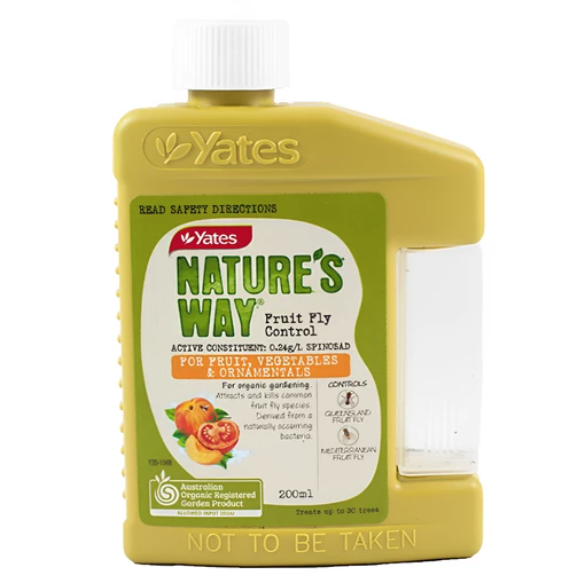
In conjunction with my trap I used to use eco-naturalure but this has now been replaced by Yates Nature's Way Fruit Fly Control. Yates Nature's Way Fruit Fly Control is a BFA registered organic fruit fly control spray for both male and female flies.
It combines specific food based attractants which target only fruit flies, and bacteria derived insecticide, spinosad, that leads to an almost instantaneous death.
You can also use fruit fly netting and fruit protection bags which are specially designed netting that you can use to cover your fruit trees or individual fruit.
I honestly believe that if every household had a fruit fly trap we could get on top of this horrendous outbreak.

What's wrong with my Citrus trees?
Citrus trees are prone to Leaf Curl and Leaf Miner. Here’s some organic methods to stop these issues.
Citrus trees are prone to Leaf Curl and Leaf Miner.
Both these problems are mainly caused by insects.
Leaf Curl can be attributed to sap-sucking pests like aphids, mites and psyllids who feed on citrus leaves by extracting the juices directly from transport tissues. As populations grow, they can cause deformations including curling and cupping in leaves, as well as discoloration.
Leaf Miner are another insect, moth larvae. Instead of sap-sucking, moth larvae tunnel through leaf tissues as they grow. These tunnels are highly visible on leaf surfaces, appearing as white or yellow lines.
I find the best way to deal with both of these pests is just trim off the affected leaves. If you wanted to spray BFA certified organic sprays like Eco-oil or Eco-fend would work. I find if I mix a little neem oil with my liquid fertiliser (Plant of Health's Triple Boost) and use it fortnightly it also reduces the harmful insect population. I try to work from a place of prevention is better than cure.
If your plants are badly affected a weekly spray for at least four weeks with Plant Care and Neem Oil, mixed together might be your magic pill!
Why Neem Oil and Plant Care?
Neem Oil is derived from the Azadirachta indica tree. When applied to insects and the plants they are eating, neem oil causes many insects to feed less, grow more slowly, molt less, and lose interest in laying eggs. Neem also suppresses the hatching of pest insects from their eggs.
Plant Care is like a vitamin pill for plants or when they’re sick or stressed. Plant Care contains natural liquid fish proteins, amino acids, liquid vermicast, fulvic acid, natural growth stimulants as well as a special blend of selected herbs and botanical extracts. Plant Care is a natural, non toxic foliar spray and can be used regularly on all plants, vegetables and lawns without the fear of NPK overload or plant damage.
Drought stress can also lead to leaf curl in citrus and is the easiest to remedy. If leaves begin to curl inward while retaining their green colour and the soil around your tree feels dry to the touch, you’re not watering enough. Step up your watering efforts and applying an organic mulch if you haven't already. If you are watering regularly then a soil wetter may be necessary. Soil Wetters help water and nutrients penetrate into the soil enabling the plants roots to pick up what they need.
Nutrient deficiencies can also lead to leaf curl. Citrus trees are very heavy feeders.
My citrus trees get Organic Link every three months and I try to liquid fertilise them fortnightly. I also like to give my trees a liquid fertilise with a complete trace element mix (I use Plant of Health's Bio-Trace) twice a year as part of my normal fertilising regime.
“Even if I knew that tomorrow the world would go to pieces, I would still plant my apple tree.” Martin Luther
I think the world would be a better place if we all took Martin Luther’s advice. We do not know what tomorrow will bring but we do know what we can do today for a better tomorrow!