Find Us:
77 Fernvale Rd
Brassall QLD 4305
(07) 3201 8630
Open:
Tue-Sun 9am - 4pm
Beyond Grevilleas: Rethinking the Australian Native Garden
How we've unintentionally narrowed our understanding of native gardening, the difference between native, indigenous and endemic plants, and why South East Queensland deserves a much broader conversation about Australia's extraordinary flora.
"I'm creating a native garden."
It's a phrase I hear almost every day at Trevallan.
On the surface, it sounds like one of the easiest requests in the world to help with. As a horticulturist, I should know exactly where to point someone.
But the longer I've worked in this industry, the more I've realised it isn't actually a simple question at all.
In fact, I think it's one of the most misunderstood conversations we have in horticulture.
Let me explain.
A Thought Experiment
Imagine I tell you I've just bought a new house. The soil is poor, the block is hot and exposed, and I've decided I'm going to create a native garden. Not just any native garden. A purist native garden. No exotics. Only Australian native plants.
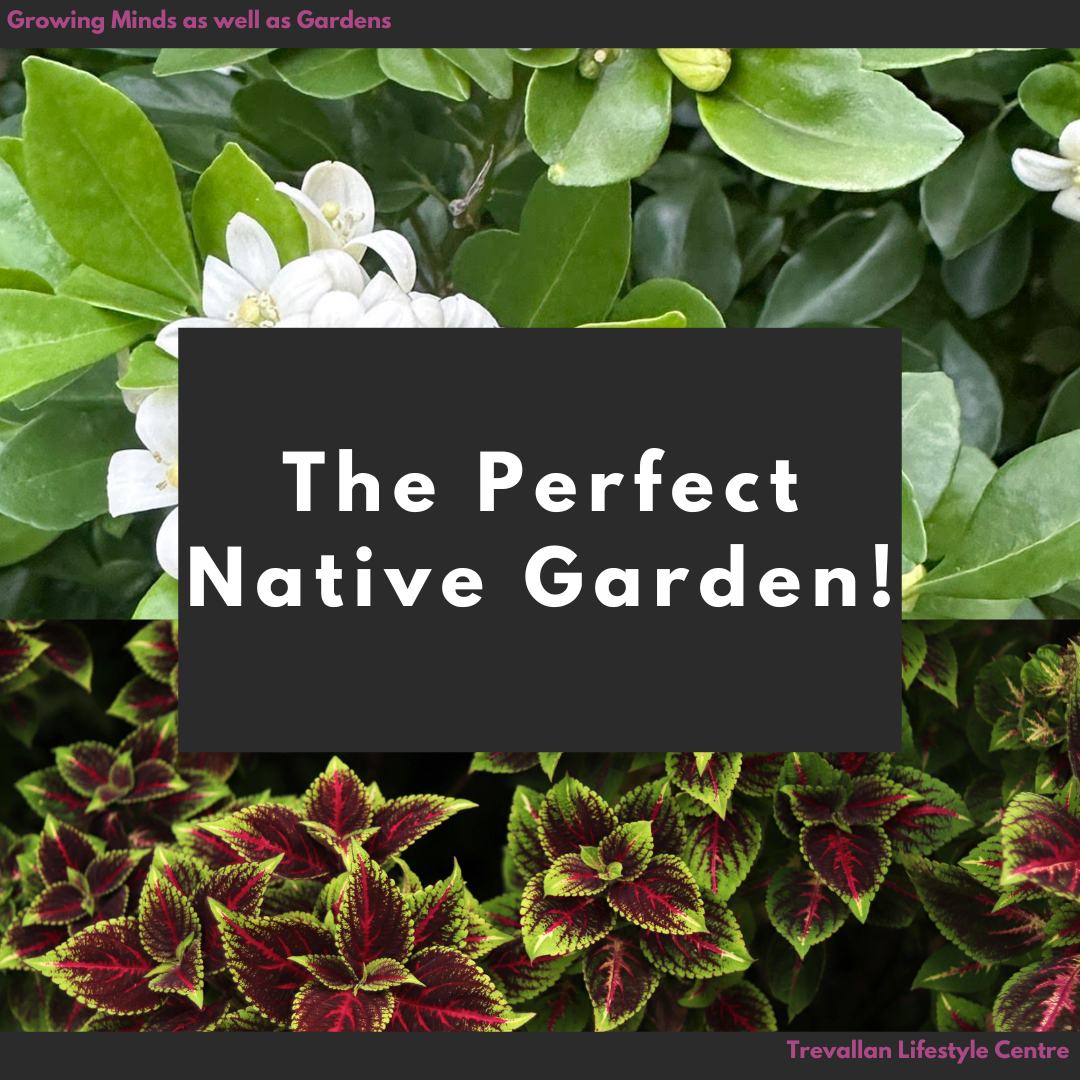
I've settled on a Murraya hedge, with colourful drifts of Coleus as the bedding plants beneath it.
How did you react?
If you're like most people, you probably paused for a second. Some of you may even have wondered whether I'd completely lost the plot. After all, when we picture a native garden, most of us immediately think of Grevilleas, Banksias, Bottlebrushes and Kangaroo Paws.
Yet here's the interesting part.
Murraya paniculata naturally occurs in northern Australia, while Coleus scutellarioides is also native to northern Australia, although both natural ranges extend into Southeast Asia and the Pacific.
So why does this garden feel wrong? The more I've thought about it, the more I think that answer says more about our perception of native gardening than it does about the plants themselves.
Somewhere Along the Way, We Created a Picture of what a Native Garden should look like
Somewhere over the years we've collectively built an image in our minds of what a native garden should look like. It usually includes Grevilleas, Banksias, Bottlebrushes, Kangaroo Paws and perhaps a few Lomandra. Now, this isn't something I have learnt from a design textbook. It's something that's slowly become obvious after thousands of conversations with customers.
Now these are all fantastic plants and I happily recommend them but they're only a tiny chapter in Australia's botanical story.
Australia has more than 24,000 native plant species. We have rainforest trees, epiphytes, orchids, palms, vines, ferns, lilies, herbs and groundcovers. There are plants that have evolved in deserts, alpine regions, wetlands, coastal dunes and subtropical rainforests. Some thrive in deep shade while others wouldn't survive without full sun.
The diversity is extraordinary.
Yet if you asked most Australians to describe a native garden, I suspect many would describe the same ten to twenty plants.
I don't think we've ended up here deliberately.
The nursery (growers) industry, gardening magazines, television programs and even local councils have naturally gravitated towards plants that have beautiful flowers, seem to be relatively easy to grow for growers and are commercially viable (looks good in a pot for an extended period of time). Grevilleas flower spectacularly, Bottlebrushes attract birds and Banksias make outstanding feature plants.
It's hardly surprising they've become the public face of Australian native gardening.
The problem isn't that these plants are popular. The problem is when they become the whole story.
What Do We Actually Mean by "Native"?
A native plant is one that occurs naturally somewhere in Australia. Some Australian native plants are found only here, while others naturally occur across Australia and neighbouring countries.
An indigenous plant occurs naturally within a particular local area or ecosystem. They are a subset of native plants that have evolved alongside the soils, climate and wildlife of that specific region.
An endemic plant is even more specialised. It is naturally restricted to one particular geographical location and occurs nowhere else on Earth.
Those distinctions might sound like botanical jargon, but they completely change the conversation.
Take Murraya paniculata as an example. It occurs naturally in northern Australia, but it is also native to parts of Southeast Asia and the Pacific. Its wider distribution doesn't make it any less Australian—it is still one of our native plants.
At the other end of the spectrum are plants that occur naturally in only a very small part of Australia. A species found only on Mount Walker, near Ipswich, is just as much an Australian native when it's planted in Sydney as a Western Australian Banksia is when it's planted in Brisbane. Neither has become any more or less Australian simply because it's growing outside its natural range.
Neither is more "Australian" than the other. They're simply native at different scales.
Then, just as you think you've got your head around that, another question appears.
What about cultivars?
Many of the native plants we grow today aren’t naturally occurring forms. They’re cultivars, plants selected or bred for particular characteristics such as more prolific flowering, compact growth, colourful foliage, disease resistance or a tidier habit. Some have been developed to fit into today’s smaller suburban gardens. Others have been selected because they flower for longer or have a more striking appearance than the original species.
So do they still count as native?
Botanically, they’re derived from native species. Ecologically, the answer depends on what you’re trying to achieve.
What I think we sometimes forget is that every breeding decision involves compromise. When we select a plant for one characteristic, we’re often changing others as well. A cultivar may have a longer flowering season, a more compact habit or brighter foliage, but that doesn’t automatically make it a better plant in every situation.
I’ve noticed this becoming more apparent over the years.
Take kangaroo paws, for example. The original taller species have earned a reputation for being tough, long-lived plants when grown in suitable conditions. Yet many of the newer compact hybrids, despite often being promoted as improved garden plants, can struggle to persist in pots through a single season in our South East Queensland climate. They look spectacular when they’re performing well, but I’ve found they can be far less forgiving than their taller relatives.
Grevilleas tell a similar story.
Compact and dwarf cultivars are incredibly popular because they flower heavily, fit neatly into modern gardens and are often promoted as low-maintenance alternatives to the larger species. Yet in Ipswich’s humidity, many of these newer selections can be more susceptible to fungal diseases and have a much shorter lifespan than gardeners expect. Meanwhile, some of the older, larger species and cultivars continue to grow happily for many years with comparatively few problems.
Does that mean cultivars are a mistake?
Not at all.
Many are outstanding garden plants and have opened Australian natives up to people with smaller gardens, balconies and courtyards. Plant breeding has given us an enormous range of beautiful plants that simply didn’t exist a few decades ago.
But I do think we’ve become a little too quick to assume that “new” automatically means “better”. Sometimes the original species has already spent thousands of years adapting to Australia’s conditions. That’s a difficult achievement for any plant breeder to improve upon.
Perhaps the question shouldn’t be whether a cultivar is better than the original.
Perhaps we should simply ask whether it’s the right plant for the place we’re asking it to grow.
And perhaps that's the question we should be asking first.
What Is Your Garden Trying to Achieve?
When someone tells me they want a native garden, I don't really want to know whether they like Grevilleas.
I want to know why.
What are you hoping to achieve?
Do you want to attract birds? If so, which ones? Nectar-feeding honeyeaters require very different plants to fruit-eating pigeons, and both have different needs to insect-eating birds or species that forage for lizards and insects through leaf litter.
Are you hoping to support butterflies? If so, are you planting nectar plants for the adults, or have you also considered the host plants their caterpillars need to survive?
Is your goal to create habitat for wildlife? Reduce water use? Restore a local ecosystem? Showcase Australian plants from across the country? Screen out the neighbours? Or perhaps you simply love the beauty and diversity of our native flora.
None of those answers are wrong.
In fact, they're all worthwhile.
But they all lead to different gardens.
A restoration project has very different goals to a suburban front yard. A wildlife garden may prioritise locally indigenous species that support particular insects, birds or mammals. A collector may delight in growing rare Australian plants from every corner of the country. Someone gardening on a small suburban block may choose compact cultivars simply because they're the right plant for the available space.
This is why I believe the question shouldn't be, "What are the best native plants?"
It should be, "What is this garden trying to achieve?"
Because once you understand the purpose, the plant selection becomes much clearer.
The Conversation We Have Every Day at Trevallan
One of my favourite conversations starts with a customer walking through the gate and asking,
"Where's your native section?"
I usually smile and reply,
"Which natives are you looking for?"
Something for full sun or deep shade?
A tree or a groundcover?
A climber?
An epiphyte?
A rainforest species?
Something indigenous to South East Queensland?
Or simply an Australian native?
There's usually a brief pause before they smile and say,
"You know... the Grevilleas."
So I start there.
Gently asking, explaining about dry rainforest plants, native herbs, climbers, epiphytes, lilies and ferns. We're talking about species they've never heard of and discovering just how incredibly diverse Australia's flora really is.
Honestly, that's one of my favourite parts of this job.
Watching someone fall in love with an Australian native plant they didn't even know existed.
South East Queensland Has One of Australia's Richest Floras
Living in South East Queensland gives us a unique perspective. We're surrounded by an extraordinary diversity of plant communities. Subtropical rainforests, dry rainforests, open eucalypt forests, wallum heathlands, wetlands, vine scrubs and coastal ecosystems all occur within a relatively small part of the country.
The diversity is remarkable.
Yet here's the challenge.
If we decided to plant only species indigenous to our own suburb, many of us would struggle to source enough plants commercially. Some of our most remarkable local species simply aren't produced in numbers large enough to supply garden centres, while others aren't grown commercially at all.
At Trevallan, we make a conscious effort to stock not only Australian plants from across the country, but also small batches of lesser-known South East Queensland natives whenever we can source them. Some of these are grown by passionate specialist nurseries, others we propagate ourselves, and many simply aren't available often enough to become everyday nursery plants.
It's something we'd love to see change.
The reality is that growers generally produce what they know will sell, and retailers can only stock what is available. Gardeners buy the plants they recognise, growers continue producing those plants, and the cycle repeats itself.
That's one of the reasons you see the same Grevilleas, Banksias and Bottlebrushes in nursery after nursery. They're excellent plants, they're reliable sellers, and they're readily available.
But beyond those familiar favourites is an extraordinary world of Australian plants that most gardeners never get the opportunity to discover.
Changing that won't happen overnight, and it won't happen because growers suddenly decide to produce different plants or customers demand something different.
Unless the media begins showcasing a broader range of Australian plants, unless gardening programs, magazines, councils, designers and landscapers stop relying on the same familiar species, and unless growers are willing to take greater responsibility for expanding what they produce, very little will change.
Garden centres can ask, encourage, educate and try to source more unusual plants, but we cannot sell what is not being grown.
That is the reality.
Growers have enormous influence over what becomes visible, available and eventually accepted by the public. If they continue producing only the plants they already know will sell, then gardeners will continue seeing the same plants, asking for the same plants and believing that those plants represent the full extent of Australian native gardening.
The media carries that same responsibility. What is repeatedly featured becomes familiar, and what becomes familiar becomes desirable. If the same Grevilleas, Banksias, Bottlebrushes and Kangaroo Paws continue to dominate magazines, television, council planting guides and social media, then lesser-known native plants remain invisible no matter how extraordinary they may be.
Retail garden centres are often left in the middle. We can try to introduce customers to rainforest species, climbers, epiphytes, herbs, ferns and locally indigenous plants, but without consistent supply and broader public awareness, those efforts remain limited.
Real change requires every level of the industry to step up.
Growers need to take more chances on underrepresented species. The media needs to broaden the plants it celebrates. Designers and councils need to specify beyond the usual shortlist. Horticultural professionals need to educate more confidently, and gardeners need to demand more than the same narrow version of a native garden.
Until that happens, we will keep talking about the extraordinary diversity of Australian flora while continuing to offer the public only a small fraction of it.ll.